

A conceptual framework in research is a visual and written model that shows the main concepts or variables in your study and how you expect them to connect. You build it from your research question, existing literature, and your own reasoning. It guides what you measure, how you design the study, and how you interpret your findings.
What Is a Conceptual Framework in Research?
The conceptual framework meaning is simple: it is your map of the study. It names the concepts you will examine, defines them, and shows how you think they relate. The word “conceptual” matters. You are organising ideas, not only listing variables.
A good conceptual framework definition has three parts. First, it is built from sources: your reading of earlier studies, relevant theories, and your own observations. Second, it is specific to your study, so two researchers working on the same topic can draw different frameworks. Third, it is testable or explorable, which means it leads directly to your research questions and method.
In practice, the framework appears twice. It is written as a short explanation in your chapter, and it is drawn as a diagram so a reader understands the whole study at a glance.
A framework is especially useful when a topic could be approached in many ways. For instance, “social media and mental health” could focus on usage time, platform type, social comparison, sleep, peer support, or self-esteem. A conceptual framework helps the researcher select the factors that best answer the specific research question.
• Show assumptions about how concepts may relate, without claiming that causation has been established.
• Explain the study’s logic to supervisors, examiners, reviewers, and readers.
• Guide analysis by linking the framework to the intended analytical approach.
• Guide data collection by showing which factors need to be measured, observed, or explored.
• Develop research questions or hypotheses where appropriate.
• Identify relevant variables or constructs instead of trying to examine everything related to the topic.
• Define the scope of the study by identifying the central concepts and boundaries.
It can help you: A conceptual framework helps researchers move from a broad topic to a focused, defensible study
Why Is a Conceptual Framework Important?
A conceptual framework helps researchers move from a broad topic to a focused, defensible study. It clarifies what will be included, what will be excluded, and why particular factors are relevant.
Five elements most conceptual frameworks contain
| Element | What it does | Example (hypothetical study) |
| Key concepts or variables | The ideas or measurable factors you study | Social media use, study time, GPA |
| Definitions | Says exactly what each concept means in your study | Social media use = self-reported daily hours |
| Relationships | Shows direction or connection between concepts | More use is linked to less study time |
| Boundaries or assumptions | States what is in scope and what you assume | Undergraduates at one university only |
| Link to your questions | Connects the model to your aims and hypotheses | RQ1 examines the association between use and GPA |
In quantitative studies, concepts are often operationalised as measurable variables or constructs, depending on the research design. The independent variable is the predictor or explanatory variable; whether it has a causal effect depends on the study design and supporting evidence. The dependent variable is the outcome. A mediator helps explain how a relationship may work; a moderator changes its strength or direction, and control variables are held constant or adjusted for. A confounder is a factor associated with both the predictor and outcome that may distort the estimated relationship if it is not addressed.
Types of Conceptual Framework
There is no single official list of conceptual framework types. The three working approaches below are useful ways to organise a framework. Choose the structure that best fits your research question: relationships between variables, a process over time, or meanings that are still being explored.
1. Variable-based (relationship) frameworks
Used in many quantitative studies, these frameworks represent variables and their proposed relationships. In this hypothetical survey example, arrows show proposed associations, not proven causes. Use causal wording only when the study design and evidence support it; for an observational survey, “is associated with” is usually safer than “causes.” A variable-based framework can help connect hypotheses with planned statistical analyses.
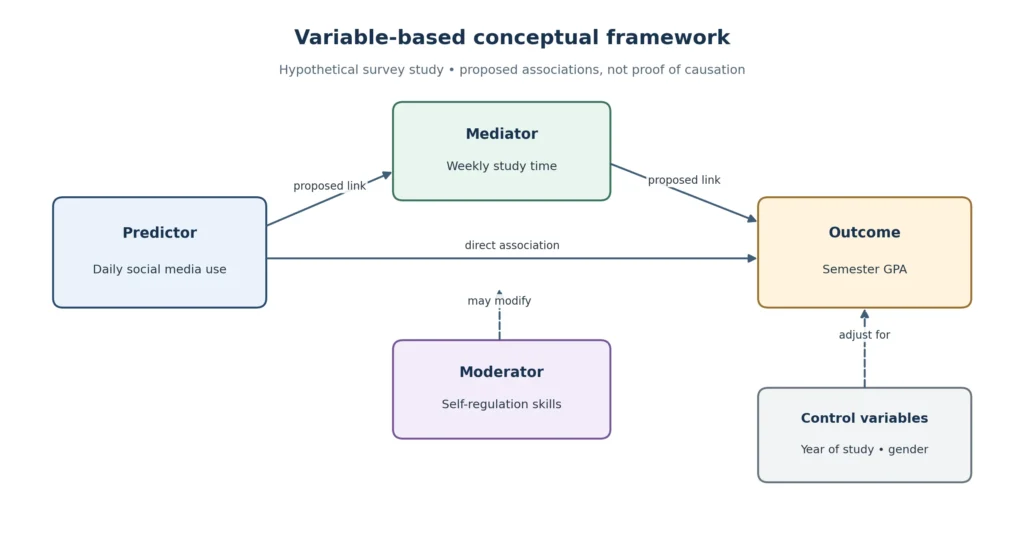
Figure 1. Variable-based conceptual framework with a mediator, a moderator and controls (hypothetical survey study)
2. Process-oriented frameworks
Used when your study is about a programme, intervention, or system. The common layout is input, process, output (IPO), sometimes with a feedback loop. Flowcharts and path diagrams follow the same logic: they show what goes in, what happens, and what comes out.
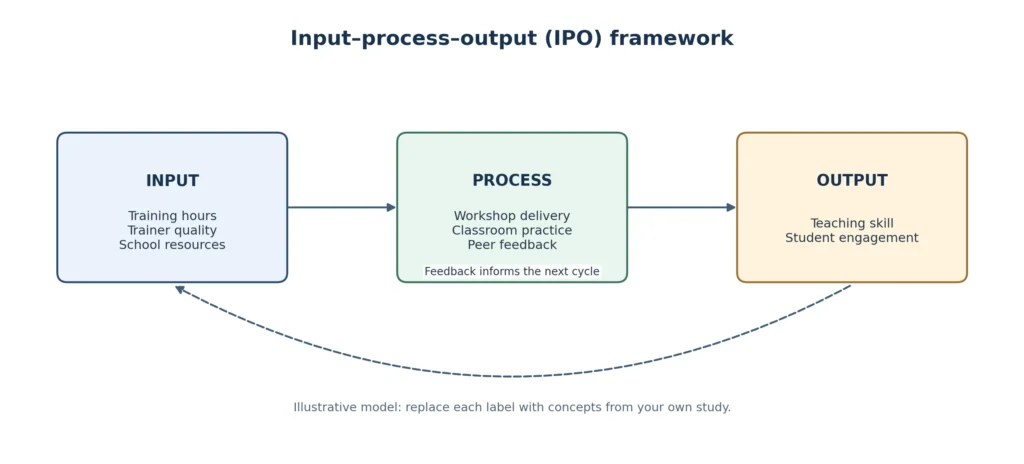
Figure 2. Input, process, output (IPO) conceptual framework (hypothetical example)
3. Exploratory or qualitative frameworks
Used in some qualitative studies, these frameworks organise concepts around a central phenomenon. Lines may indicate connections to explore rather than causal relationships. The framework can remain flexible and change as themes emerge from the data. An exploratory concept map is one common approach in qualitative research, although structures vary by discipline and methodology.
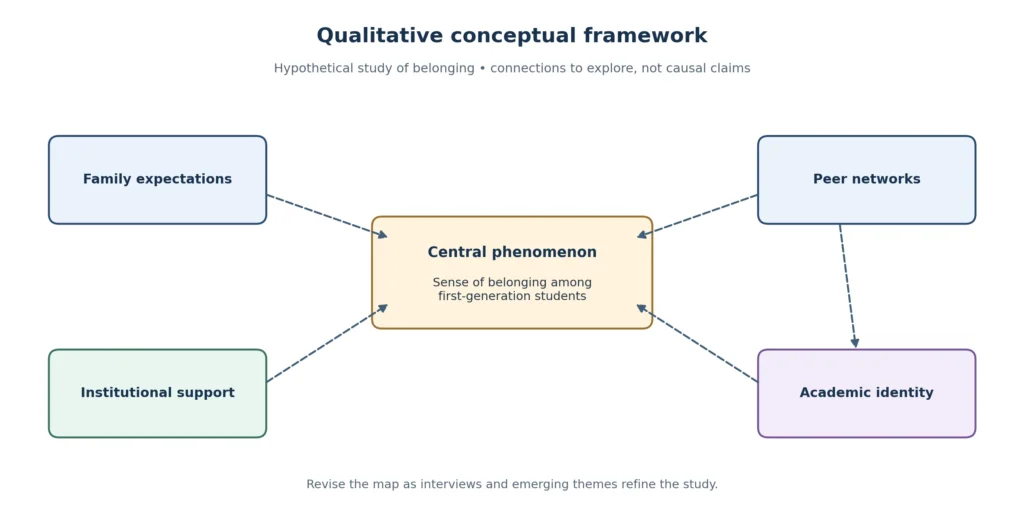
Figure 3. Qualitative conceptual framework shown as a concept map (hypothetical example)
The terms conceptual framework and conceptual model are sometimes used interchangeably, although their meanings can vary by discipline. Whichever diagram you choose, keep it readable. As a practical starting point—not a fixed rule—five to ten boxes may be enough for a relatively simple study; the right size depends on the model’s complexity. Some researchers also use taxonomic frameworks (classifications of categories) or mathematical models. Check your department’s guidance before choosing a less familiar format.
Conceptual Framework Examples in Research
The examples below are illustrative and show different ways to structure a framework. They are not excerpts from published studies, so adapt the logic to your own research question and supporting literature rather than copying the wording.
Example 1: Quantitative study
Topic: Social media use and academic performance among undergraduates. Question: Is daily social media use associated with semester GPA, and does study time help explain the link?
- Independent variable: daily social media use (hours, self-reported).
- Dependent variable: semester GPA.
- Mediator: weekly study time. Moderator: self-regulation skills.
- Controls: year of study and gender.
- Hypotheses: H1: Higher use is associated with lower GPA. H2: Study time partly accounts for this association. H3: The association is weaker for students with strong self-regulation. This is a survey design, so the wording avoids claiming cause.
Figure 1 shows this model. Each arrow represents a proposed relationship that can be examined with suitable data and analysis. For additional practical guidance, see our guide to quantitative research examples.
Example 2: Qualitative study
Topic: How first-generation students experience belonging at university. Question: Which experiences shape their sense of belonging?
Here the framework is a concept map (Figure 3). The sensitising concepts are family expectations, peer networks, institutional support and academic identity. You do not claim they cause belonging. You use them to shape interview questions, then revise the map when participants raise new themes.
Example 3: Process or programme study
Topic: Evaluating a teacher training programme. Question: Are training inputs associated with better teaching skills and student engagement?
The IPO layout in Figure 2 fits because the study follows a programme from resources to results. The feedback arrow reminds you that outcomes can change future inputs, which is useful for evaluation research.
Example 4: A sample conceptual framework paragraph
| Sample paragraph (hypothetical). This study adopts a conceptual framework linking social media use, study time, and academic performance. Daily social media use is the independent variable (predictor), and semester GPA is the dependent variable. Weekly study time is proposed as a mediator because time spent online may reduce time available for study. Self-regulation is treated as a moderator that weakens the link between use and GPA. Year of study and gender are included as controls. The framework is drawn from the studies reviewed in Chapter 2 and guides the hypotheses and analysis in Chapter 3. |
Conceptual Framework vs Theoretical Framework
These two terms are often confused, and some universities use them loosely. In the clearest usage, a theoretical framework is built on one or more established theories, while a conceptual framework is the model you assemble for your own study, drawing on theory, evidence and your reasoning. For a clear academic treatment, see Grant and Osanloo’s paper on understanding and using frameworks in dissertation research. Varpio and colleagues also explain why theory, theoretical framework and conceptual framework are different things.
| Point | Conceptual framework | Theoretical framework |
| Source | Your synthesis of literature, theory and logic | One or more established theories |
| Scope | Specific to your study | Broader, reusable across studies |
| Typical form | Diagram of variables or concepts | Named theory and its propositions |
| Main job | Shows what you will examine and how | Explains why relationships should exist |
| Needed? | Requirements vary by discipline, institution, and research design. Check your thesis handbook and supervisor’s guidance. | Same: check what your department expects |
Do you need both? Often yes, and they work together: the theory explains why, and your conceptual framework shows what you will test. Some programmes accept only one. Ask your supervisor which your department expects.
Concepts versus theories. A concept is a single idea, such as motivation or belonging. A theory is a set of connected claims about how concepts behave. Your conceptual framework arranges concepts. A theory supplies reasons for the arrangement.
A note on accounting. In accounting and financial reporting, “conceptual framework” means the standard-setters’ document on the objectives and qualities of financial information. That is a different use of the term and is not what this guide covers.
How to Make a Conceptual Framework Step by Step
Learning how to make a conceptual framework becomes easier when you treat it as a process of reasoning rather than drawing boxes first. The following steps provide a practical starting point, though the order may vary by project and supervisor expectations.
Step 1 — Define the Research Problem and Question
Start with a focused research problem. A vague topic such as “online learning” is too broad; a clearer question might be, “How do first-year students experience engagement in fully online courses?”
Your research question determines what belongs in the framework. If your question concerns experiences, the framework may emphasize meanings, processes, and context. If it concerns associations or effects, it may emphasize variables and proposed pathways. Clear research question examples can help you narrow a broad topic into a researchable focus.
Step 2 — Review Relevant Literature
A literature review identifies what is already known, which concepts are commonly used, and where evidence is incomplete. It also helps you avoid treating a personal assumption as an established finding.
When reviewing literature, look for:
- Repeatedly used concepts or constructs
- Established definitions and measurement approaches
- Evidence about relationships between concepts
- Theories that explain the phenomenon
- Contexts, populations, or methods that remain under-researched
A strong framework emerges from this review rather than appearing independently of it. If you are unsure how to organize this stage, this guide to what RRL is in research explains the purpose of a review of related literature.
Step 3 — Identify the Main Concepts or Variables
Select only the concepts needed to answer the research question. For a quantitative study, identify the independent, dependent, mediating, moderating, and control variables where relevant. For qualitative research, identify the central phenomenon, important themes, contextual conditions, and processes.
Define each concept clearly. For example, “academic performance” could mean examination scores, cumulative grades, assignment marks, or teacher-assessed performance. The definition should match how you will measure or examine it.
Step 4 — Determine the Proposed Relationships
Explain why the concepts are connected. Use prior research, theory, and logical reasoning to justify each proposed link.
Be precise about the type of relationship:
- A direct relationship proposes that one concept is associated with another.
- A mediating relationship proposes that one concept explains how another influences an outcome.
- A moderating relationship proposes that one concept changes the strength or direction of another relationship.
- A contextual relationship proposes that a setting or condition shapes how a process occurs.
An arrow in a conceptual framework diagram should represent a specific proposed relationship. It should not be added merely to make the diagram look complete.
Step 5 — Choose a Structure That Fits the Study
Choose a structure that reflects your research design. A variable-based model may suit an experimental or survey-based study. A process model may suit research on decision-making, adaptation, or implementation. A contextual model may suit organizational, community, or policy research.
Avoid forcing a qualitative study into a simple cause-and-effect diagram if the research question is exploratory. The framework should fit the evidence you intend to collect.
Step 6 — Draw the Conceptual Framework Diagram
Create a simple, readable conceptual framework model after you have clarified the logic. Use boxes for concepts, arrows for proposed relationships, and labels where the relationship needs explanation.
A good diagram is not necessarily the most detailed one. It should make the study easier to understand, not harder.
Step 7 — Explain and Refine the Framework
Do not rely on the diagram alone. Write a short narrative that explains:
- What each box represents
- Why each concept is included
- What each arrow or connection means
- Which relationships are established in prior research and which are exploratory
- How the framework informs the research design
Your framework may change as you read more literature, refine your questions, collect preliminary data, or receive supervisor feedback. Treat it as a working model, not a permanent fixture. If your supervisor asks for clearer logic, consider our research consultancy service.
Where Does the Conceptual Framework Go in a Thesis or Dissertation?
Placement depends on your university, so check your handbook first. The usual options are:
- End of Chapter 2 (literature review): a common option when the literature review builds toward the framework.
- Start of Chapter 3 (methodology): useful when the framework drives your design and measures.
- Brief version in Chapter 1: a short preview, with the full framework developed later.
In a journal article, the framework may be explained in a concise paragraph and figure in the introduction, literature review, or methods section, depending on the discipline and journal format.
Conceptual Framework Template You Can Copy
Fill in each line, then turn the answers into a diagram.
| Prompt | Your answer |
| Main research question | – |
| Concept 1 and definition | – |
| Concept 2 and definition | – |
| Concept 3 and definition | – |
| Role of each concept (independent, dependent, mediator, moderator, control, or theme) | – |
| Expected relationships and the source supporting each | – |
| Assumptions and scope | – |
| Research questions or hypotheses this framework leads to | – |
Mini thesis wording: “This study is guided by a conceptual framework that links [concept A], [concept B], and [concept C]. [Concept A] is expected to be associated with [concept C], as shown in Figure [number]. The framework draws on [sources] and informs [research questions].
Common Mistakes to Avoid
- Listing variables with no relationships. A set of boxes is not a framework. Show how they connect.
- Copying a published diagram. Examiners expect a model built for your question.
- Adding arrows you cannot justify. Each link needs support from literature or clear reasoning.
- Mixing up theory and framework. Name the theory separately if you use one.
- Never using it later. Your hypotheses, survey items, or interview guide should visibly follow the framework.
Frequently Asked Questions
A study of social media use and GPA could show social media use as the independent variable, GPA as the dependent variable, study time as a mediator, and self-regulation as a moderator, all drawn as a diagram with arrows.
Three common working types are variable-based frameworks for quantitative studies, process-oriented frameworks such as input, process, output, and exploratory concept maps for qualitative studies.
Key concepts or variables, their definitions, the relationships between them, the boundaries or assumptions of the study, and the link to your research questions.
Yes. In qualitative work, it shows sensitising concepts and possible connections rather than tested variables, and it can change as your data reveal new themes.
There is no fixed length. A framework may include a diagram and a short explanatory narrative, but the expected format and length vary by discipline, institution and study design.
No. The literature review surveys existing knowledge. The conceptual framework is the model you draw from that review to guide your own study.
Final Thoughts
A strong conceptual framework gives your thesis a clear spine. It shows your examiners what you are studying, why the concepts belong together, and how your method follows from them. Start with your research question, ground every link in evidence, draw it simply, and keep it consistent with your hypotheses and methods.
If your conceptual framework highlights gaps in existing research, our manuscript editing services can help you refine your thesis and prepare your manuscript for journal submission.