
Who is the paper written for?
The intended scholarly audience helps narrow journals whose readership and subject focus match the research.
Audience fitPublishing in a suitable Web of Science journal starts with more than finding an indexed title. Your manuscript needs a clear subject fit, current journal verification, appropriate academic presentation and careful preparation for the journal's own submission requirements. Our Web of Science journal publication service supports researchers from manuscript assessment and journal verification through preparation and submission readiness, without promising acceptance or replacing independent editorial review.











Web of Science is a research discovery and citation platform from Clarivate that includes curated scholarly collections. For researchers, a journal's presence in Web of Science provides useful information about its coverage and scholarly context, but indexing alone does not make a journal suitable for a particular manuscript. Current coverage, subject relevance, article type and journal-specific author requirements should all be checked before submission.
A journal should not be shortlisted from an index label alone. We look at the manuscript and the journal together so the recommendation has a clear academic reason behind it.
The intended scholarly audience helps narrow journals whose readership and subject focus match the research.
Audience fitOriginal research, reviews and other article types can have different journal options and preparation requirements.
Article compatibilityThe manuscript's research question, methods and contribution are compared with the journal's stated aims and scope.
Scope alignmentAuthor instructions, required files and journal-specific preparation points are reviewed before the submission stage.
Submission readinessWhy this matters: database coverage confirms where a journal is indexed; manuscript fit helps determine whether it is a sensible publication target. Both checks belong in the decision.
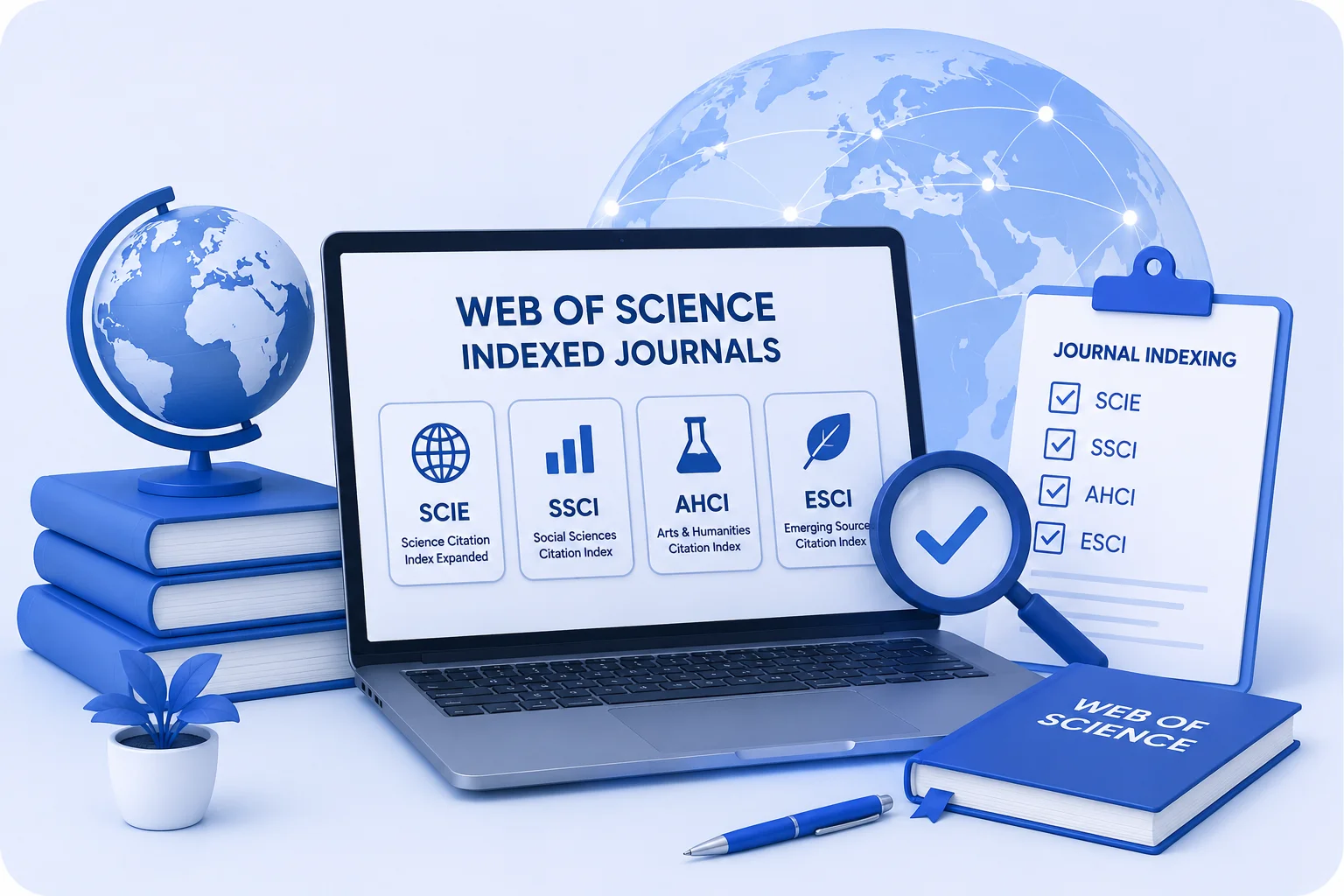
Researchers searching what is Web of Science often encounter several index names. These labels describe different parts of the Web of Science Core Collection and should be interpreted in the context of the journal's subject area and current status.
SCIE covers journals across science, engineering, technology and related disciplines. If you are researching what is SCI journal or SCI journal meaning, verify the journal's current SCIE coverage rather than relying on loose third-party use of the term SCI.
An SSCI journal is associated with social-science research coverage, including relevant areas such as business, economics, psychology, education and related disciplines.
An AHCI journal relates primarily to scholarly work across arts, humanities and associated disciplines. Scope fit still matters even when the journal is correctly indexed.
An ESCI journal forms part of the Web of Science Core Collection. Its presence should not automatically be described as SCIE, SSCI or AHCI, so the exact collection should be confirmed.
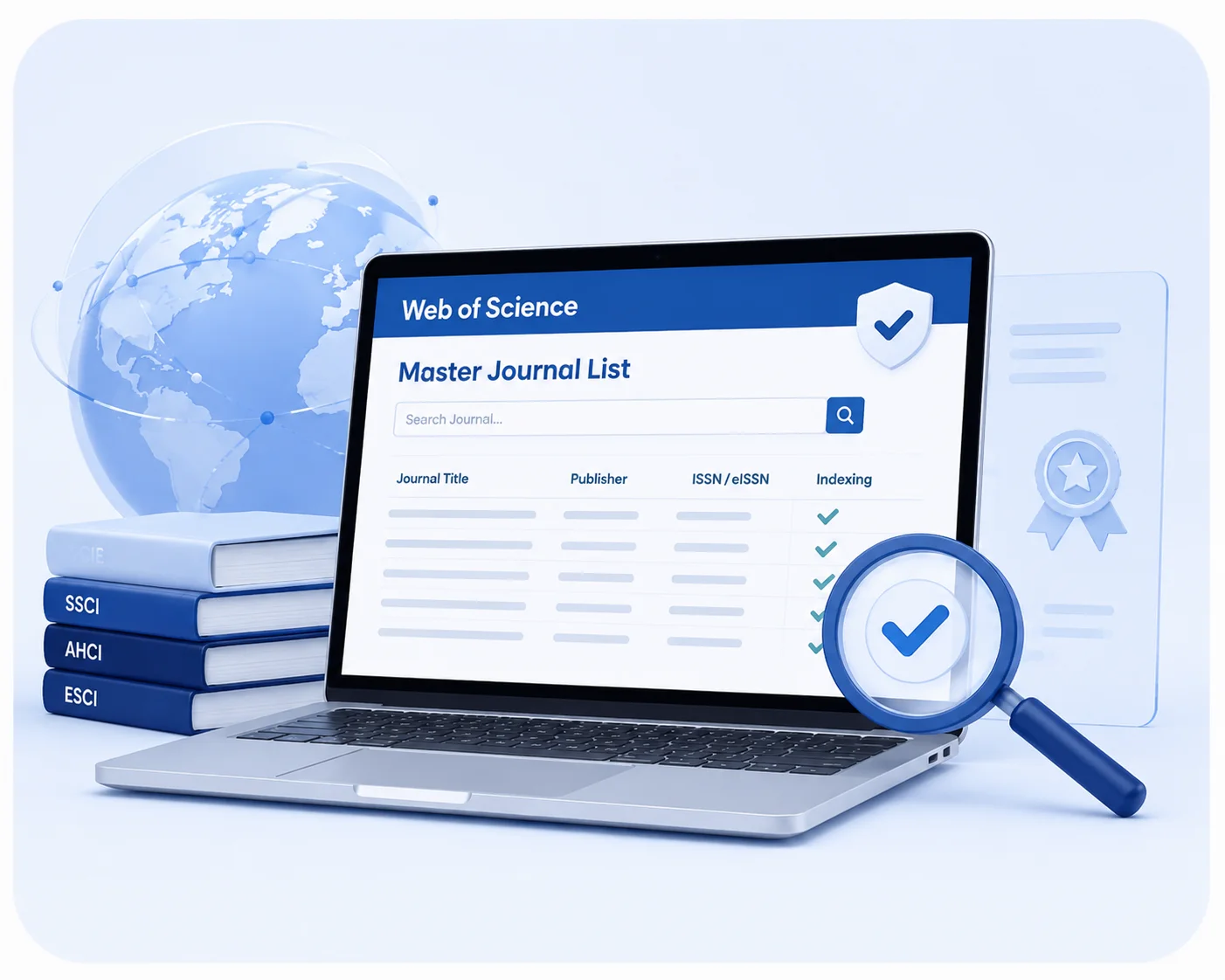
The Web of Science master journal list is an important starting point for checking journal coverage and identifying the relevant Web of Science collection. Finding a title is only the first step. A useful journal assessment also considers the journal's identity, current coverage, research scope, article type and stated submission requirements.
Within our Web of Science publication service, the verification route is straightforward: research topic → journal identification → current WoS coverage → relevant index → scope fit → article type → author requirements. This helps reduce dependence on outdated third-party lists and unsupported claims made elsewhere online.
Our Web of Science journal publication support is structured around the manuscript rather than a one-size-fits-all package. Journal selection, preparation and submission support are handled as separate steps so you can see what is being checked and why.
The workflow keeps journal verification, manuscript preparation and submission readiness as distinct stages, so you can see what is being checked before the paper moves forward.
We review the research area, manuscript type and publication requirements.
Potential titles are considered according to subject alignment and manuscript characteristics.
Current WoS coverage, relevant collection and journal requirements are checked.
Agreed editing, formatting and required files are aligned with the selected journal.
If feedback is received, revision guidance may be provided according to the selected service.
The exact deliverables depend on the selected service and manuscript requirements. Our Web of Science journal publication service provides defined preparation outputs, while Web of Science journal publication assistance remains focused on readiness rather than promises about publication outcomes.
Publication needs and preparation priorities identified before submission work begins.
Available current WoS coverage and relevant collection information reviewed.
Journal-specific formatting and manuscript issues addressed where included.
Required files, author instructions and revision support reviewed as applicable.
Journal suitability depends on both the research discipline and the individual manuscript. We support a broad range of academic areas while checking the appropriate Web of Science collection, scope and article type for each paper.
Clinical, biomedical, pharmaceutical, biological and health-related research.
Engineering, computing, information technology and applied technical research.
Management, finance, accounting, economics, marketing and related disciplines.
Psychology, education, policy, sociology and interdisciplinary social research.
History, philosophy, literature, cultural studies, arts and humanities research.
Chemistry, physics, mathematics, environmental science and Earth-related research.
Coverage does not mean every journal in a field is suitable for every manuscript. The journal's current WoS status, collection, scope and submission requirements are checked separately.
Web of Science covers research across very different disciplines, but manuscript expectations are not identical. We account for the conventions that matter in your field before a journal submission is prepared.
Research articles, reviews and other article types can follow different section structures depending on the discipline and target journal.
Medicine, engineering, social sciences and humanities present methods, evidence and limitations in different ways.
Technical terminology, disciplinary language and the level of explanation are reviewed in the context of the intended readership.
Reference style, source presentation and citation conventions are checked against the journal's own author instructions.
Presentation requirements for tables, figures, data and supporting material can vary substantially between research areas.
Science and engineering, social sciences, arts and humanities, and interdisciplinary research may lead to different SCIE, SSCI, AHCI or ESCI journal options.
The value of our Web of Science journal publication service is not simply receiving a list of names. A Web of Science indexed journal publication decision also needs the right context. Researchers need to understand why a journal is being considered and what should be checked before submission.
Coverage can change, so old lists should not automatically be treated as evidence of a journal's current status.
Database coverage does not make every indexed title suitable for every manuscript or article type.
Individual journals and publishers set their own author instructions, required files and submission workflows.
SCIE, SSCI, AHCI and ESCI are identified in context rather than treated as interchangeable labels.
Research accuracy, originality and academic decisions remain with the author throughout the process.
Support improves submission readiness but does not control peer review, acceptance or publication timing.
Our Web of Science journal publication service is built around current journal information, manuscript-specific guidance and clear boundaries around independent editorial decisions.
Journal status is reviewed using current available Web of Science information instead of static assumptions.
Preparation follows the intended journal's stated author and submission requirements where applicable.
Editors and peer reviewers remain responsible for revision, acceptance, rejection and publication decisions.
We do not guarantee journal acceptance, publication dates, reviewer decisions, citation performance, a particular indexing outcome or continued database coverage. Authors remain responsible for the originality, accuracy and academic integrity of their research.
Preparing a manuscript for a Web of Science indexed journal involves more than improving writing or formatting. Each journal can set its own requirements for article structure, word limits, references, figures, supplementary files, declarations and submission documents.
Our Web of Science journal publication assistance can include reviewing the requirements relevant to the selected journal and identifying preparation points that need attention before submission. Web of Science does not establish one universal manuscript format for every journal; individual journals and publishers set their own author instructions.

These terms are useful journal signals, not guarantees of manuscript acceptance. Current coverage and the journal's own editorial information should still be checked.
The most appropriate journal is not determined by an acronym alone. Research scope, audience, article type and journal requirements should remain part of the decision.
| Index | Main research context | What researchers should verify |
|---|---|---|
| SCIE | Science and related disciplines | Current coverage, subject category, scope and article fit |
| SSCI | Social sciences | Current coverage, category, audience and research relevance |
| AHCI | Arts and humanities | Current coverage, discipline, scope and article requirements |
| ESCI | Broad scholarly coverage | Current status, scope, subject context and manuscript suitability |
Journal Impact Factor and JCR information should be checked in current Journal Citation Reports data. Since the 2023 JCR release, Clarivate expanded JIF coverage to journals across the Web of Science Core Collection, including AHCI and ESCI.
Each service addresses a specific stage of publication so this page remains focused on Web of Science preparation rather than competing with dedicated journal-selection or editing pages.
Our Web of Science journal publication service provides structured support from journal verification and manuscript preparation through submission readiness, with clear boundaries around independent editorial and peer-review decisions.