Submitting to the wrong journal costs you months - a mismatched scope, an unrealistic acceptance rate, or a title that turns out to be predatory. Our journal selection service matches your manuscript to journals it actually fits, ranked by impact, quartile and realistic acceptance odds, so your submission goes to the right desk the first time. Whether you need a one-off journal recommendation service for a single paper or ongoing journal selection assistance across every submission you make, the same scope-matching, legitimacy-checked process applies.
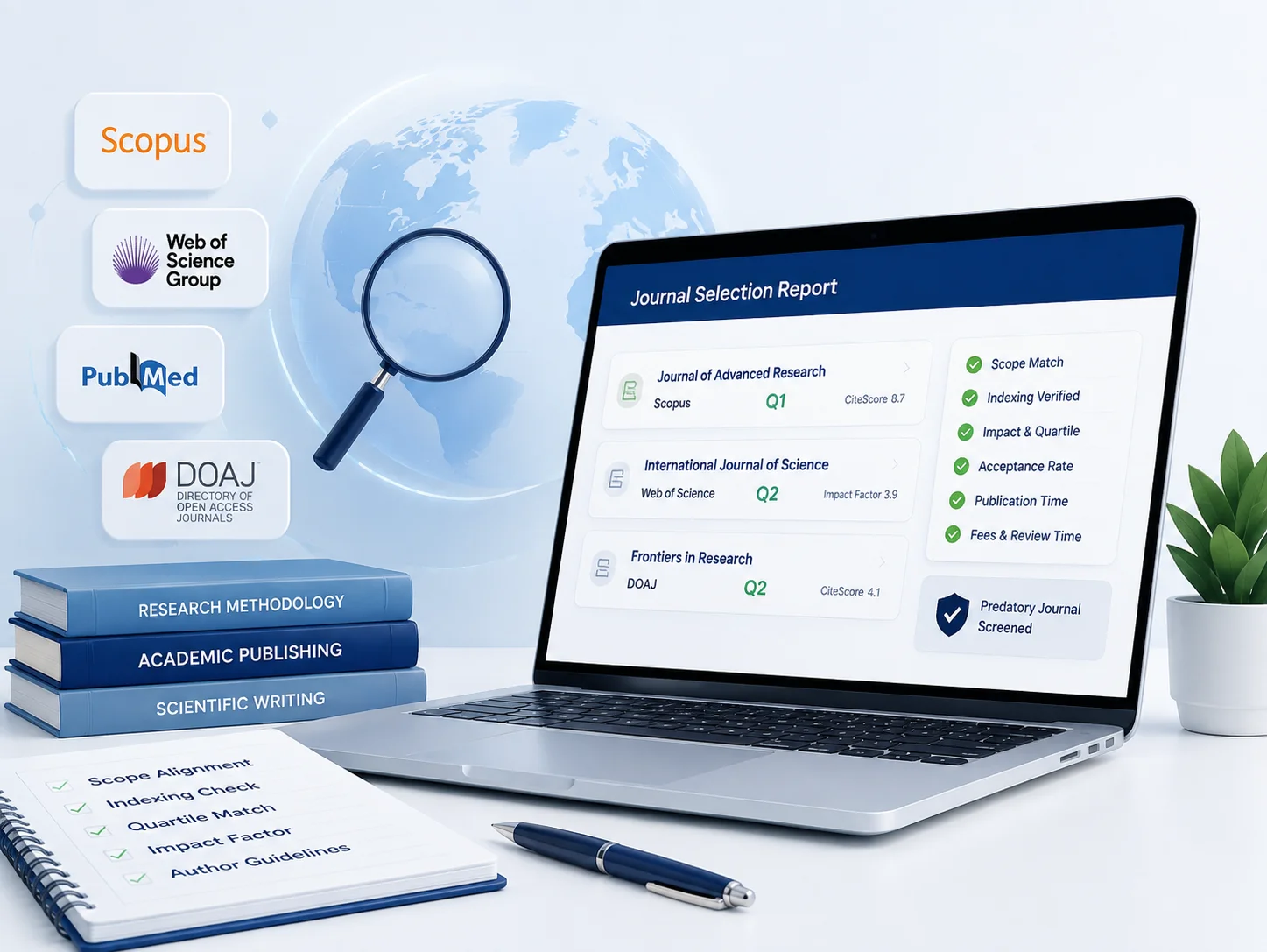













A journal selection service matches your manuscript to journals within its actual scope, cross-checked for legitimacy, then ranked by quartile (Q1–Q4), impact metrics and realistic acceptance likelihood. You receive a shortlist with the reasoning behind each recommendation, not a single guess at where to submit.
A journal recommendation service is a form of journal matching for manuscripts: instead of you scanning journal websites one by one, a subject-matched reviewer runs your paper's scope, methodology and contribution against hundreds of candidate titles at once. The output isn't a single guess - it's a ranked, reasoned shortlist that functions as manuscript-to-journal matching done properly, with the evidence behind every recommendation shown, not hidden.
This is where target journal selection becomes a repeatable process rather than a one-time hunch. Every candidate journal goes through the same journal fit assessment: does the paper's subject sit inside the journal's stated scope, does the citation profile match what your paper realistically competes at, and does the acceptance pattern for similar papers make it a sensible submission target. That's the journal suitability assessment behind every recommendation we send you.

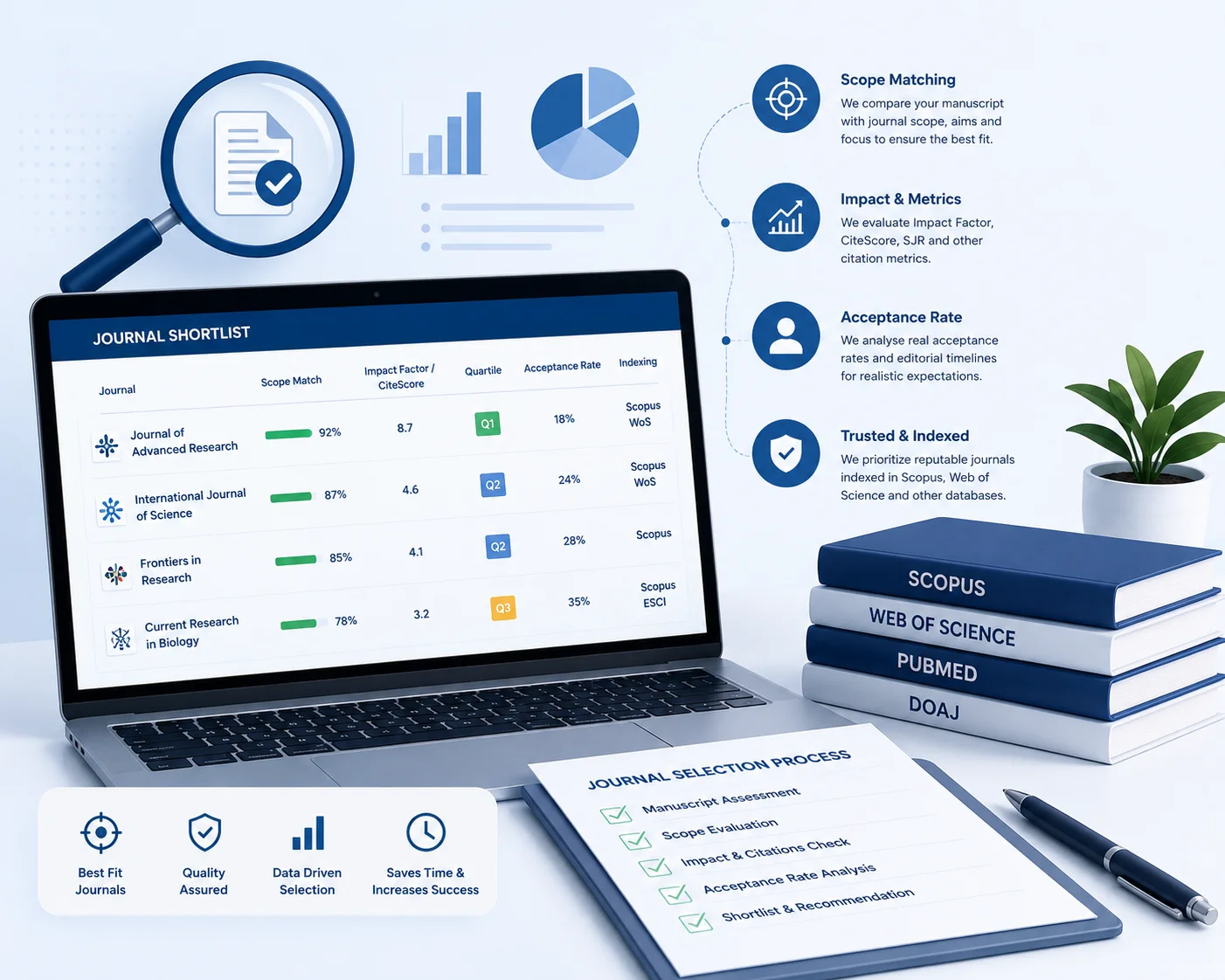
We start with your manuscript's actual subject, methodology and contribution, then run it against journal scope statements across Scopus and the Web of Science master journal list - not just a keyword match. Every candidate journal is checked on three factors together, not one in isolation: how closely its scope fits your paper, where it sits on impact and citation metrics, and what its realistic acceptance rate looks like for a paper like yours.
The result is a shortlist built around fit, not just prestige - a journal ranked highly but outside your paper's scope is not a match, and we won't recommend it as one. This is the core of target journal selection: we don't hand you a list of famous names, we hand you target journal recommendations for research papers specifically like yours, each one defensible against your paper's actual scope and citation profile. A journal that's prestigious in general but wrong for your specific subject area isn't progress - it's a slower route to the same rejection.
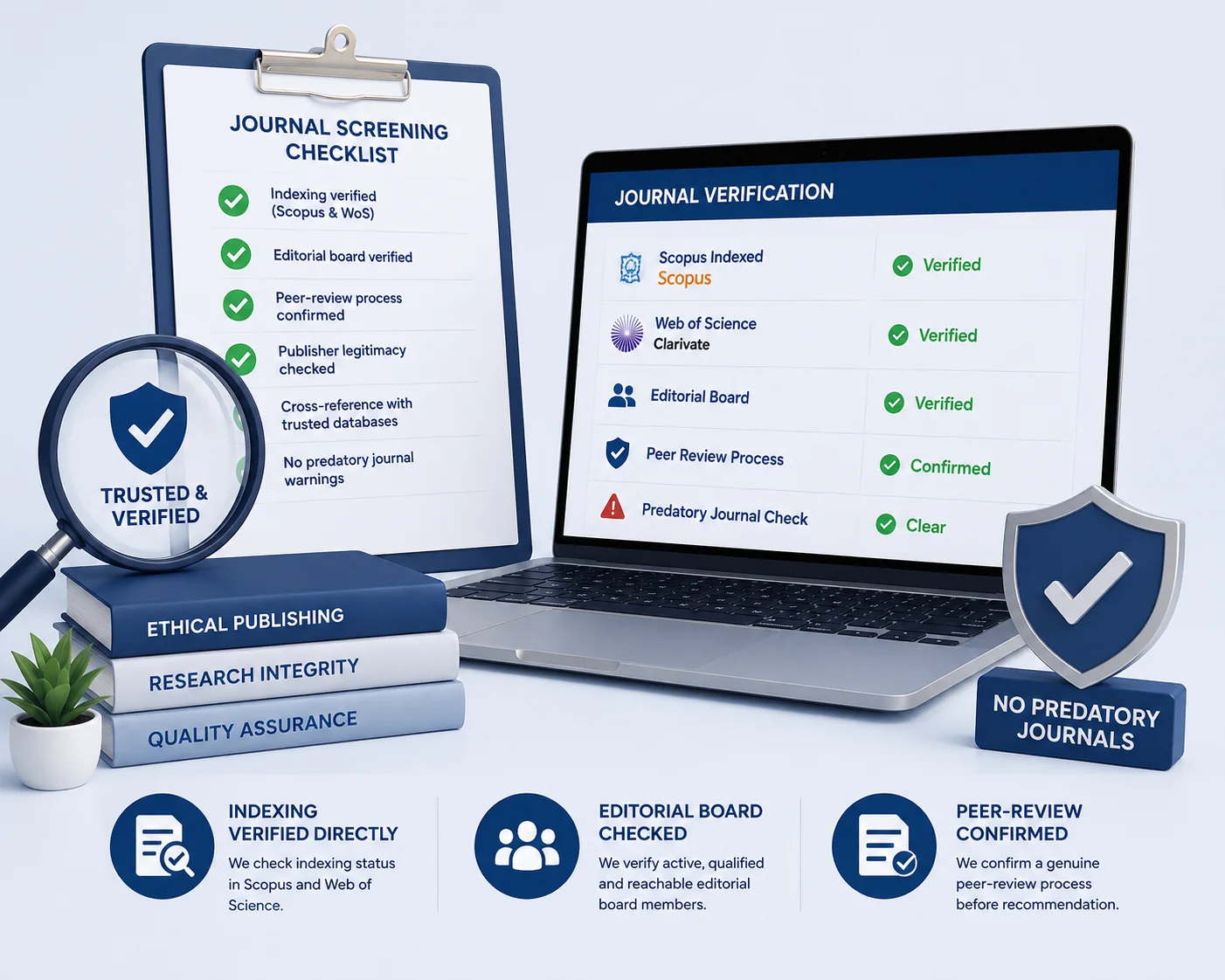
A predatory journal charges publication fees without delivering genuine peer review, often with a fabricated editorial board and an indexing claim that doesn't hold up. Submitting to one can cost you the paper, the fee, and your credibility with it.
Every journal we recommend is checked against its claimed indexing status directly with Scopus and Web of Science, verified for an active, contactable editorial board, cross-referenced against known predatory-journal watchlists, and confirmed for a real peer-review process before it reaches your shortlist. If a journal fails any of these checks, it's excluded - regardless of how it markets itself. This screening step runs before any scope or quartile matching happens, so a predatory title never gets the chance to look like a legitimate recommendation.
A journal's quartile ranks it against other journals in its own subject category, based on citation impact - Q1 is the top 25% in that category, down to Q4 in the bottom 25%. We match your paper to the quartile it realistically competes in, then show you options a step above for stretch submissions. This is quartile-aware target journal selection: a Q1 recommendation only makes the shortlist when your paper's scope and citation profile genuinely support it, not because Q1 sounds more impressive on a CV.
Highest impact tier in the subject category. Competitive, longer review times.
Strong reputation with a more realistic acceptance window for most papers.
Solid, legitimate outlets - often faster review and decision cycles.
Lower impact tier, useful for niche or early-stage research areas.
We work across the databases and indexes researchers actually need to be listed in, not just one. A journal that looks impressive on its own website means little if it isn't genuinely indexed where your institution, funder or field expects - so we verify status directly against each database below rather than trusting a journal's own claim.
Elsevier's abstract and citation database, one of the most widely required indexes for academic output.
Science, Social Sciences and Arts & Humanities Citation Indexes, plus the Emerging Sources Citation Index.
The primary index for biomedical and life sciences literature.
Directory of Open Access Journals - vetted, legitimate open-access titles.
DOI registration and metadata verification for journal legitimacy checks.
NLM's biomedical literature index, cross-referenced during screening.
Five steps from first message to a verified, ranked shortlist.
Send your abstract or full paper and subject area on WhatsApp - no forms, no account needed, and your file is treated as confidential from the first message.
We shortlist candidate journals by scope fit, impact metrics and quartile, drawing on the Scopus and Web of Science master journal list rather than a single database.
Each candidate is checked for genuine indexing, editorial board and peer review before it's allowed onto your shortlist at all.
You receive a ranked shortlist with the reasoning, acceptance-rate context and journal data behind each option.
Pick your target journal - we can carry straight into formatting and submission support from there.
No account, no forms, no obligation to proceed further.
Across all our journal selection services, every order produces a written journal recommendation report - a journal shortlist for manuscript submission that documents the reasoning, not just the names, so you can see exactly why each title made the cut.
Shortlisted specifically for your manuscript's scope.
Where each journal sits on citation metrics and Q1–Q4 ranking.
What realistic odds look like for a paper like yours.
Typical decision timelines reported for each journal.
The same subject-matched model we use across all Scopus Journal Publications services - our coverage spans every discipline below, not a narrow list of "core" subjects.
Journal selection assistance helps at several different points in the publishing journey - here's where researchers use it most.
Choosing a first target journal without years of submission history to draw on.
Need a journal matching service to find a better-fit title, not the same mismatch twice.
Tenure, promotion or grant reporting requirements that call for a Q1 or Q2 outlet.
Need one agreed shortlist instead of every co-author proposing a different journal.
Ongoing journal shortlisting service support across multiple faculty submissions.
Want independent, third-party verification before paying any journal's publication or processing fee.
A generic journal matching service optimizes for speed. Our journal selection services optimize for a submission that actually lands somewhere legitimate and realistic for your paper.
Faster turnaround than most agencies in the market, with rapid options for tight deadlines.
Reviewed by an expert who works in your field.
Every recommendation passes our legitimacy screening first.
Reasoning and data behind every recommendation, not a guess.
Refund available where our service conditions aren't met - details in the FAQ below.
Talk to your review team directly - no ticket queue.
Whether it's a single journal recommendation service request or ongoing journal selection assistance, every order runs under the same checkable standards, built on the same journal scope matching foundation.
Our predatory-journal checks follow Committee on Publication Ethics guidance on identifying deceptive publishers.
Indexing status is checked directly against Scopus and Web of Science, not taken from a journal's own claims.
Every recommendation is reviewed by someone who works in your specific field, not a generalist.
Each journal recommendation report shows the scope, quartile and acceptance-rate reasoning behind it - nothing is a bare assertion.
A redacted example from an actual journal selection service order, showing the format every recommendation follows.
[Journal name] - peer-reviewed, Scopus & WoS indexed, subject: applied materials science.
Q2 in category. Scope overlap: 92% - methodology and subject area align closely.
Realistic acceptance window based on recent issues in this journal's subject area.
One line explaining the specific fit - not just "good journal," but why this one, for this paper.
This is the same journal fit assessment format used for every order, regardless of subject or quartile.
We show this example because most journal-matching claims are easy to make and hard to verify. Seeing the actual structure of a recommendation - the specific quartile, the scope-overlap figure, the one-line reasoning - is a better basis for trust than a general promise that "we'll find you a good journal."
Free journal-finder tools have a real place - they're a fast way to generate a first list of candidate titles by matching your abstract's keywords against journal scope pages. But keyword matching is where they stop. They don't verify whether a journal's claimed indexing is current, whether its editorial board is real and contactable, or whether the acceptance pattern for papers like yours actually supports the recommendation. A title can rank near the top of an automated tool's results and still fail a basic legitimacy check.
Our journal selection service starts where those tools stop: every candidate that clears the initial scope and keyword pass then goes through a subject-matter PhD reviewer's journal suitability assessment, direct index verification, and a manual predatory-journal screen. The result is a shorter, more trustworthy list - usually four to five journals instead of forty - with the legitimacy work already done, not left for you to verify title by title.

Sharing an abstract or manuscript for journal selection means sharing unpublished work. It's handled only by the reviewers assigned to your file, kept confidential throughout the selection process, and never shared, resold or reused. This applies equally to a single-paper request and to ongoing journal selection assistance across multiple manuscripts.
A non-disclosure agreement is available on request for institutions, journals or authors who require one before sharing a manuscript.

Every journal on your shortlist is checked against these indicators before it reaches you.
This is exactly why journal selection assistance exists: manual searching misses the things that matter most - legitimacy, realistic acceptance odds and quartile fit.
| Factor | Searching it yourself | Our journal selection service |
|---|---|---|
| Scope-fit accuracy | Based on manual keyword searching | PhD subject-matter review |
| Predatory journal risk | Easy to miss red flags | Verified before recommendation |
| Quartile & impact data | Time-consuming to compile | Included in your report |
| Acceptance-rate context | Rarely available publicly | Reported per journal |
| Time to a usable shortlist | Hours to days of searching | Delivered as a ranked report |
Send your manuscript or abstract on WhatsApp. A subject-matched PhD expert will screen and shortlist journals for you, no obligation the same journal fit assessment and legitimacy checks used on every full journal selection service order, just scaled down to three free recommendations so you can see the quality before committing to anything larger.
Get My Free Recommendations on WhatsApp