

Research objectives are clear, specific statements of what a study intends to accomplish when it investigates a defined research problem. Many student projects have one general objective and several specific ones, often three to five, depending on scope, design, and institutional rules. Each objective starts with an action verb such as describe, compare, explore, or assess.
What Are Research Objectives? Meaning and Definition
In simple terms, research objectives describe what a study intends to accomplish when it addresses a defined research problem. Each one names an action, such as describe, compare, or identify, and a focus, such as a variable, a group, a process, or an experience.
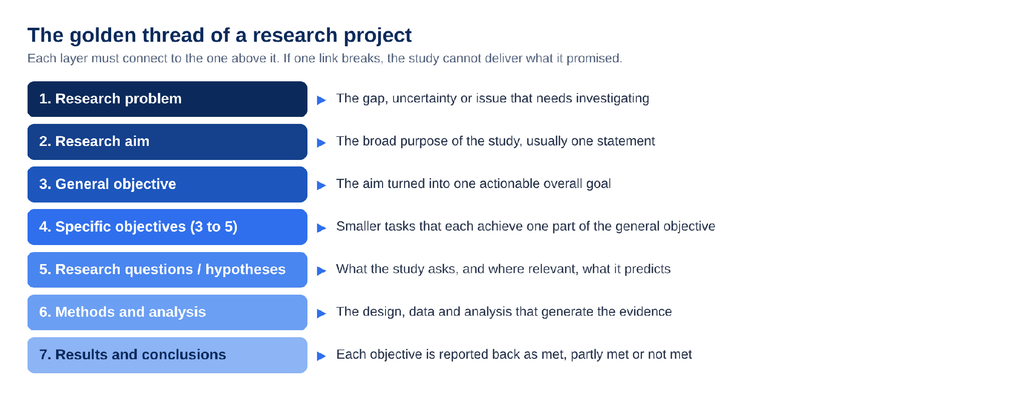
Figure 1: How research objectives connect the problem to the conclusions.
Types of Research Objectives
You can group the main types of research objectives in two ways: by level (general and specific) and by purpose (descriptive, exploratory, explanatory, and so on).
General Objective in Research
A general objective in research states the overall goal of the study in one actionable sentence. It stays on aim, but it describes what the study will do instead of what the researcher hopes to understand.
Specific Objectives in Research
Specific objectives in research break the general objective into smaller tasks. Each one covers a single aspect of the overall goal, and the planned data and methods must be able to answer it.
Types of Research Objectives by Purpose
Purpose-based labels describe the kind of task a study performs. They also help you choose a verb and a design.
| Type | What it does | Example objective |
|---|---|---|
| Descriptive | Documents characteristics or current conditions. | To describe the dietary habits of urban teenagers aged 13 to 17 in one city. |
| Exploratory | Investigates a poorly understood issue | To explore how freelance workers experience income uncertainty in their first year. |
| Explanatory | Examines relationships or possible explanations. | To examine whether classroom noise level relates to reading comprehension in Grade 5. |
| Comparative | Compares groups, settings, or conditions. | To compare patient satisfaction between public and private outpatient clinics. |
| Evaluative | Assesses a program, policy, or intervention. | To evaluate first-year retention among students in a peer-mentoring program, compared with similar non-participants. |
| Predictive | Estimates outcomes from known factors. | To develop a model that predicts customer churn from usage data. |
| Methodological | Builds or validates a tool or method. | To validate a short questionnaire measuring academic self-regulation. |
Research Aims vs. Objectives
Research aims vs. objectives is one of the most common points of confusion, and many writers treat the two as the same thing. They are not. The aim is the destination: the broad purpose of the whole study. Meanwhile, the objectives are the route: the specific things the study will do to get there. So if you wonder what comes first, the aim does.
- Research aim: To understand how remote work arrangements relate to employee burnout in mid-sized software firms.
- Objective 1: To measure burnout levels among fully remote, hybrid, and on-site employees.
- Objective 2: To compare burnout scores across the three work arrangements.
- Objective 3: To identify the job demands that employees most often link with burnout.
SMART Research Objectives
SMART research objectives are Specific, Measurable, Achievable, Relevant, and Time-bound. The acronym comes from a 1981 article on management goals (Doran, 1981). Since then, education and research have adopted it widely. It works best as a final check, not as a first-draft tool.
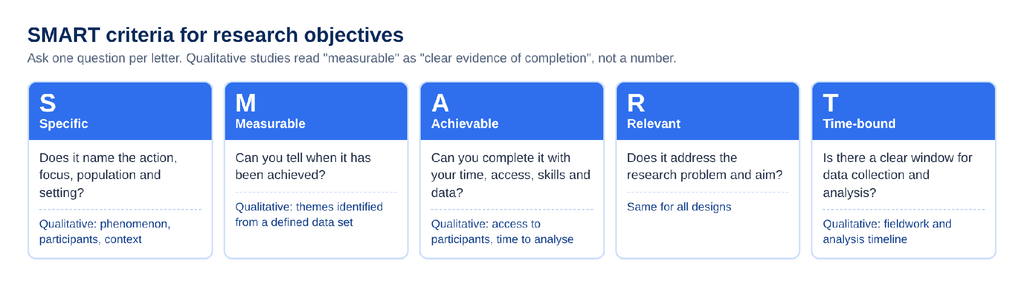
Figure 2: SMART criteria for research objectives, with the qualitative reading under each letter.
For example, here is a weak objective put through the test. Weak: “To study social media use among students.” Stronger: “To measure average daily social media use among undergraduates at one university during the autumn semester, using a self-report survey.”
SMART Objectives for Qualitative Research
SMART can feel built for numbers, so a fair question follows: can qualitative research have measurable objectives? Yes, if you read “measurable” as “there is clear evidence of completion.” A qualitative objective needs no score. However, it does need a defined phenomenon, participants, a setting, and a way of generating evidence.
How to Write Research Objectives
When you wonder how to develop research objectives from a rough idea, work through the eight steps below. Formulating research objectives moves from a broad problem to precise statements.
Step 1: Pin Down the Research Problem
State the issue, gap, or contradiction that the study will address. A review of related literature (RRL) helps here, because it shows what researchers already know, where findings conflict, and which gap deserves attention.
Step 2: Write the Research Aim
Write one broad statement of the study’s overall purpose. Keep it tied to the problem, but resist the urge to answer everything in one project.
Step 3: Identify Key Concepts, Variables, or Experiences
In quantitative work, that usually means predictors, outcomes, and possible covariates. In qualitative work, however, it may mean experiences, perceptions, decisions, or processes.
Step 4: Write the General Objective
Convert the aim into one actionable goal that names the main focus and the population.
Step 5: Break It Into Specific Objectives
First, ask what the study must describe, compare, examine, or explore to achieve the general objective. Then order your answers from foundation to analysis to synthesis.
Step 6: Choose Precise Action Verbs
Pick the verb after you decide what the study will produce. The verb table later in this guide shows which verbs promise which kind of evidence.
Step 7: Align Objectives With Questions and Methods
Each objective needs data and an analysis that can deliver it. The alignment section further down shows typical pairings, so check your draft against it.
Step 8: Test and Revise
First, read each objective aloud and ask whether another researcher would understand the intended focus. Next, run the SMART check and remove duplicates. Finally, ask a supervisor or peer to challenge anything that sounds vague.
Research Objectives Format and Template
Most well-formed objectives follow one pattern: action verb, focus, population, and setting or timeframe.
Research objectives template
To [action verb] [variable, concept, or experience] among/in [population] [in setting or timeframe].
Filled example: To compare exam anxiety scores between first-year and final-year pharmacy students at one university in the 2026 academic year.
Worked Example – From Research Problem to Objectives
This study focuses on social media use and academic performance among university students. The research problem is that students spend considerable time on social media, but its relationship with academic performance at one university remains unclear. It investigates the relationship between daily social media use and academic performance among undergraduate students.
Research Objectives Examples
These examples of research objectives are hypothetical, so they show how to word objectives, not what a study found.
Research Objectives Example in Health Sciences
- Aim: To investigate whether hand hygiene compliance changes after a training program among intensive care nurses.
- General objective: To assess changes in hand hygiene compliance among nurses in one intensive care unit following a training program.
- Specific objectives: To describe baseline compliance by shift; to compare compliance before and after training; to identify the barriers nurses report.
Research Objectives Example in Business
- Aim: To understand how loyalty program membership relates to repeat purchasing in online retail.
- General objective: To examine the relationship between loyalty program membership and repeat purchase frequency among customers of one online retailer.
- Specific objectives: To measure repeat purchase frequency for members and non-members, to compare average order value between the two groups, to identify the program features that members value most.
Research Objectives Example in Education
- Aim: To understand how a flipped classroom model relates to student engagement in undergraduate statistics.
- General objective: To assess student engagement in a flipped undergraduate statistics course across one semester.
- Specific objectives: To describe students’ attendance and participation patterns; to examine students’ perceptions of pre-class video lessons; to compare engagement.
Research Objectives Example in Engineering
- Aim: To determine whether recycled aggregate can partly replace natural aggregate in structural concrete.
- General objective: To evaluate, in a controlled laboratory experiment, the effect of recycled aggregate content on the compressive strength of concrete.
- Specific objectives: To measure compressive strength at 7 and 28 days for 0, 25, and 50 percent replacement; to compare results across the mixes.
Quantitative Research Objectives Examples
Research objectives in quantitative research involve variables that you can count, measure, or categorize systematically. Each one should also name the variables and the population. Verbs such as measure, estimate, compare, determine, and test fit well. For more designs and analysis choices, see these quantitative research examples. The quantitative research objectives examples below cover different designs:
- To estimate the prevalence of iron-deficiency anemia among women aged 15 to 49 in two districts.
- To compare average commute time between cyclists and drivers in one city.
- To determine, in a randomized controlled trial, whether a 12-week resistance training program increases grip strength relative to a control group.
- To assess whether employee training hours predict customer satisfaction scores after controlling for store size.
Qualitative Research Objectives Examples
Research objectives in qualitative research focus on experiences, perceptions, meanings, and processes.
- To explore how first-generation undergraduates experience academic advising during their first year.
- To identify the main themes in how mature students describe returning to study, using semi-structured interviews and thematic analysis.
- To describe the strategies that teachers use to manage mixed-ability classrooms in two secondary schools.
- To interpret how community health workers understand their role during a vaccination campaign.
Mixed Methods Research Objectives
Mixed methods studies usually combine one overall objective, an objective for each strand, and an objective that states how the strands connect.
- General objective: To examine how and why older adults use an online patient portal.
- Quantitative objective: To measure portal login frequency and its relationship with age and digital confidence.
- Qualitative objective: To explore older adults’ reasons for using or avoiding the portal.
- Integration objective: To integrate the survey results and interview findings to build a fuller understanding of older adults’ use of the portal.
Research Objectives for a Systematic Review
For a systematic review, objectives state what evidence the team will identify, appraise, and synthesize.
Research Objectives vs Research Questions vs Hypotheses
Research objectives, questions, and hypotheses do different jobs, so mixing them up is a common reason proposals come back for revision.
An objective is not simply a research question without the question mark. Rewording a question as “To examine…” does not make a good objective unless it names an accomplishment that the data can deliver. Taken together, the objectives should cover the questions the study claims to answer. You do not, however, need exactly one objective per question. For question formats and wording options, see these research question examples.
Not every design needs a hypothesis. Hypotheses fit studies that test a predicted relationship, while many exploratory and qualitative studies work without them. To learn how to word and test one, read our guide to the research hypothesis.
Aligning Research Objectives With Research Methodology
Research objectives in research methodology decide what the study must measure or explore, and the methodology explains how it will do so. The matrix below shows typical pairings. Treat them as starting points, not rules, because the right choice also depends on your sample, data quality, and assumptions. For a fuller map of philosophy, approach, design, and methods, see this guide to research methodology.
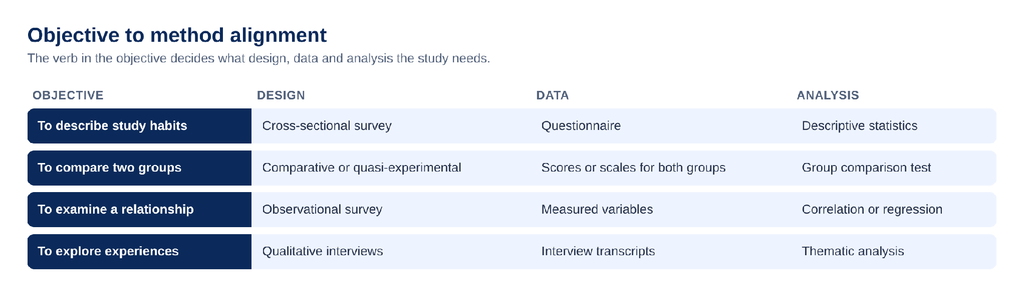
Figure 3: How the verb in an objective points to a design, data source, and analysis.
Research Objectives for a Thesis, Dissertation, or Proposal
Research Objectives in a Research Proposal
When you write objectives for a research proposal, place them after the problem statement and before the methodology, and link the gap you found to the planned design.
“This study aims to examine the relationship between sleep duration and self-reported concentration among undergraduate students. Specifically, it will describe students’ average sleep duration over a two-week period.
Research Objectives for a Thesis or Dissertation
Research objectives for a dissertation, like those for a thesis, need extra attention to scope. A master’s project, for example, usually works with a narrow set of objectives and a single study.
Specific Aims in Grant Applications
Funders often use their own term. The National Institute of Allergy and Infectious Diseases explains that Specific Aims in a grant application typically rest on research objectives, such as testing a stated hypothesis, creating a new design, or addressing a critical barrier in the field.
How to Write Research Objectives for a Research Paper
Journal articles are shorter than theses, so objectives usually shrink to one or two sentences at the end of the introduction: a statement of the aim, followed by what the study specifically did. Re
This matters when you turn thesis chapters into papers. Five thesis objectives rarely fit into one article. Therefore, choose the objectives that form a single publishable question and rewrite them to match. A thesis-to-journal-article conversion service can help restructure the chapter around that focused set while keeping the findings and their meaning unchanged
Final Takeaway
Clear research objectives turn a broad interest into a manageable study. In short, write a focused aim, break it into specific and feasible objectives. If you would like a second pair of eyes on your objectives, aims, or design before you start collecting data, our research consultancy support can review the structure with you.
Frequently Asked Questions About Research Objectives
Research objectives are the specific goals that a study sets out to achieve. Each one begins with an action verb and names a focus, such as a variable, group, or experience.
For example: “To compare exam scores between students who use spaced revision and students who do not, at one university during one semester.”
There is no official list of ten. However, commonly cited purposes of research include exploring, describing, explaining, comparing, predicting, evaluating, and developing or validating tools.
The aim comes first. It states the broad purpose, and you then derive the objectives from it as the specific tasks that achieve that purpose.
There is no universal number. Three to five is common for student projects, but the right number depends on scope, design, available data, and institutional rules.
An objective states what the study will accomplish, whereas a hypothesis is a testable prediction about a relationship.
SMART research objectives are Specific, Measurable, Achievable, Relevant, and Time-bound. The framework works as a quality check.
Yes. Qualitative objectives need no numerical scores. However, they should define the phenomenon, participants, setting, and expected output, such as themes from a set number of interviews.
Name the measurable variables, the population, and the setting. Then choose verbs such as measure, compare, estimate, or assess.
Focus on a defined phenomenon, group, and context, and use verbs such as “explore,” “identify,” “describe,” or “interpret.”
Objectives state what the study will accomplish, while methodology explains how the study will do it, including the design, data collection, and analysis that justify those choices.
Minor refinements during planning are normal, especially in iterative qualitative work. After data collection begins, major changes may need supervisor or ethics approval.