

A theoretical framework is the established theory, or set of related theories, that a researcher uses to explain a research problem and to guide how a study is designed, analyzed, and interpreted. It names the key concepts and assumptions, justifies why the theory fits the problem, and links each concept to the research questions.
What Is a Theoretical Framework in Research?
Theoretical framework definition – A theoretical framework is an established theory, or a set of related theories, that a researcher uses to explain a research problem and guide the design and interpretation of a study. It identifies relevant concepts and assumptions, explains relationships proposed by the theory where applicable, and shows how the researcher will use them. The exact form varies by discipline and research tradition.
The theoretical framework of a research project is not a list of theories, and it is not a summary of earlier studies. It is an argument: this theory helps explain this problem for these reasons, and here is how it will guide the study. A good one also states the theory’s assumptions openly and says where the theory stops explaining.
Theory vs Theoretical Framework
A theory is a general explanation of how or why something happens (Abend, 2008). The framework is your use of that theory in one study: which parts you adopt, why you adopt them, and how they steer the work. Kivunja (2018) reviewed the literature because students so often struggle to explain how theory, theoretical framework, and conceptual framework differ, and that confusion is the reason this guide spends time on the distinction.
Another Word for Theoretical Framework
You will see “theoretical lens,” “theoretical perspective,” “theoretical underpinning,” and “theoretical basis” used for much the same idea. They overlap, but check what your supervisor expects. Some programs use “lens” for a lighter, interpretive use of theory and reserve “framework” for a fuller structure with defined constructs.
Why Is a Theoretical Framework Important?
A framework gives a study a reasoned foundation, so the work does not read as a pile of unconnected measurements. Depending on the design, it helps you in these ways:
- Builds the intellectual foundation. It shows which ideas the study stands on.
- Explains why the problem matters. It moves the study from describing a situation to explaining it.
- Connects your work to existing knowledge. Readers can see how the study relates to earlier research.
- Guides questions or hypotheses. Where suitable, the theory suggests what to ask or test.
- Informs interpretation. It gives you a way to read findings, including surprising ones.
- Keeps the study consistent. The problem, method, and analysis can all be checked against one line of reasoning.
- Exposes limits. It shows where the theory may not apply, which is often where new questions begin.
Key Components of a Theoretical Framework
A written framework often contains six parts. The first four are generally grounded in the theory and relevant literature; the final two make your study-specific reasoning explicit. This is a teaching structure, not a university rule, so adapt it to your handbook and discipline.
| Component | What it contains | Question it answers |
| 1. Named theory and source | The theory, its originator, and the version you use (some theories have several) | Which established explanation guides this study? |
| 2. Core concepts | The theory’s main constructs, defined in its own terms | What are the building blocks? |
| 3. Relationships | Propositions about how the constructs relate, stated at the level of theory | What does the theory expect to happen? |
| 4. Assumptions and limits | What the theory takes for granted and where it stops applying | When should this theory not be trusted? |
| 5. Justification of fit | Why this theory beats the alternatives for your problem and context | Why this theory and not another? |
| 6. Link to your study | How constructs become your variables, questions, codes, or themes | Where does the theory touch my data? |
Types of Theoretical Framework
There is no single official list of theoretical framework types, and you should be wary of any page that presents one as settled. In practice, student frameworks tend to fall into four patterns:
1. Single Theory
- Uses one established theory to explain the entire research problem.
- Provides a central explanation for the study’s concepts and expected relationships.
- Example: Using Self-Determination Theory to examine student motivation.
- Main limitation: A single theory may not explain every aspect of a complex research problem.
2. Multiple Theories
- Combines two or more established theories to address different aspects of a research problem.
- Each theory serves a specific purpose within the theoretical framework.
- Example: Combining a theory of individual behavior with organizational theory to examine workplace practices.
- Main limitation: Using multiple theories without explaining their individual roles can make the framework disconnected.
3. Theoretical Lens or Perspective
- Uses a broader theoretical perspective to guide how the researcher examines and interprets a research problem.
- Helps identify relevant social, cultural, political, or institutional influences.
- Examples: Intersectionality and Critical Theory.
- Main limitation: A theoretical perspective may become a general viewpoint rather than providing clear direction for research questions and analysis.
4. Adapted or Extended Model
- Builds on an existing theoretical model by modifying or adding concepts to suit a particular research context.
- Allows researchers to address factors that the original model may not fully explain.
- Example: Extending the Technology Acceptance Model by adding trust as an additional factor influencing technology adoption.
- Main limitation: Modifications without theoretical justification or supporting evidence can weaken the framework.
Theoretical Framework vs Conceptual Framework
A theoretical framework is grounded in established theory. A conceptual framework is your own map of the concepts, variables, and expected relationships in one study, and it may draw on one or more theories. The distinction is useful but not absolute. Varpio et al. (2020) show that the terms are often conflated and that their meaning shifts between deductive studies, which move from theory to data, and inductive studies, which move from data toward theory. Our guide to the conceptual framework in research covers the conceptual side in full.
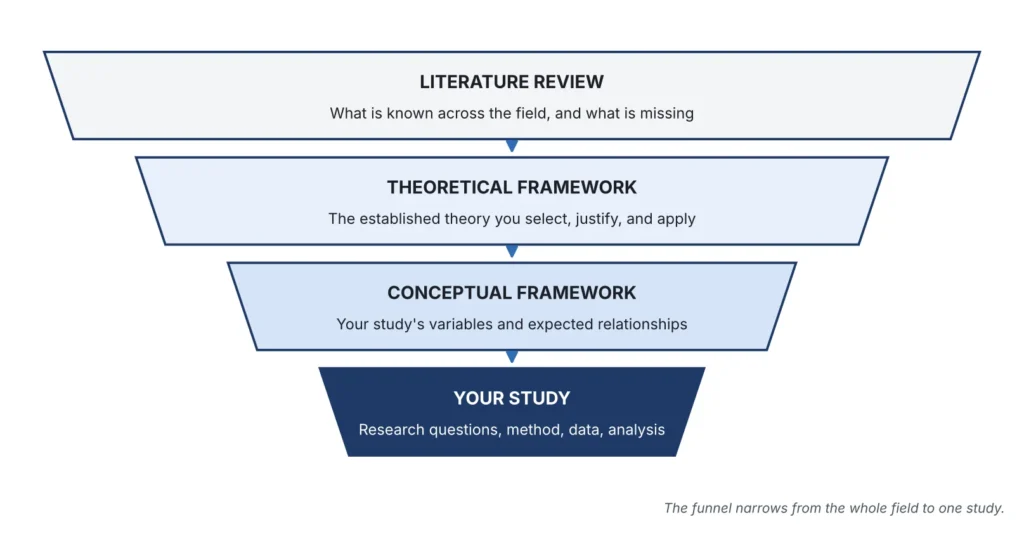
Figure 1. How the literature review, theoretical framework, and conceptual framework relate. Each stage narrows the focus toward your study.
Note: This diagram illustrates one common deductive research structure. The relationship and sequence may differ in exploratory, inductive, and other research traditions.
| # | Literature review | Theoretical framework | Conceptual framework |
| Question answered | What is already known, and what is missing? | Which theory explains this problem? | How do the variables in my study relate? |
| Source | Many studies and sources | One or a few named theories | Built by you from theory and prior research |
| Scope | The wider field | A focused explanation | Your study only |
| Typical form | Organized discussion | Written argument, sometimes with a model | Diagram with defined variables |
| Main job | Maps the field | Explains and interprets | Guides measurement and analysis |
Do You Need Both?
- Hypothesis testing studies often use both: the theory explains why, and the conceptual framework shows which variables you will test.
- Interpretive qualitative studies may need only a theoretical lens, with no variable diagram.
- Exploratory or grounded theory studies may start with neither. If so, say so and explain why.
Whether you need a conceptual and theoretical framework together depends on design and department. When in doubt, look at two or three recent theses from your department. Local convention matters more than any general rule.
How to Write a Theoretical Framework Step by Step
To write a theoretical framework, start with the research problem and work outward. The eight steps below can be adapted for a thesis, a research proposal, or a journal article.
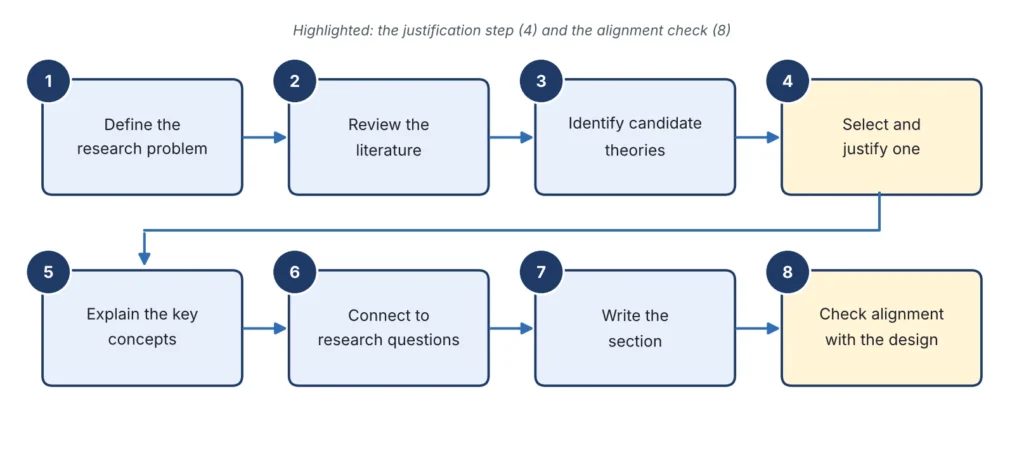
Figure 2. The eight steps for writing a theoretical framework.
Step 1. Define the Research Problem
State the problem and the question you want to answer. A clear problem narrows the field, because only some theories speak to the kind of issue you are investigating. What goes wrong: a topic (“online learning”) is mistaken for a problem (“engagement varies widely between students in the same course”).
Step 2. Review the Relevant Literature
Read how earlier researchers approached your problem. Note the theories they used, the concepts they treat as important, the debates between them, and the gaps they leave. A defensible framework usually takes shape as this review develops.
Step 3. Identify Candidate Theories
List the theories that could explain your problem. For each, check relevance to your question, assumptions, scope, fit with your discipline, and how well earlier studies have supported it. Theories borrowed from another field can add insight, but you will need to show why they apply.
Step 4. Select and Justify Your Theory
Choose the theory that best explains your problem and say why. “This theory is widely used” says nothing about fit, whereas “this theory explains voluntary behavior, and my participants are not required to act” does. One well-justified theory is often enough. Several are reasonable when each does a different job that you can state in a clause. If you are unsure which theory fits, a methodological discussion with your supervisor or research consultancy services can help you test your shortlist.
Step 5. Explain the Key Concepts
Define only the concepts that matter to your study, in the theory’s own terms, and explain how each relates to your problem. If a concept is introduced here, it should reappear in your questions, measures, or analysis.
Step 6. Connect the Theory to Your Research Questions
Show how the theory shapes what you ask. In a hypothesis-driven study, it may suggest the hypotheses and variables. In an interpretive study, it may supply sensitizing ideas for your questions and codes. If you are still drafting the questions themselves, these research question examples show how different types are worded.
Step 7. Write the Theoretical Framework Section
Do more than summarize the theory. Describe it briefly, justify your selection, explain its relevance, acknowledge its limits, and show how it will guide the study. Name the key theorists and cite the original source where possible. Use a consistent tense: present tense often works when explaining what a theory proposes, while past tense is appropriate when describing what earlier researchers did. A diagram can help readers follow the logic, but some frameworks are clearer in words alone.
Step 8. Check Alignment With the Research Design
Test whether the framework fits your objectives, methodology, data, and planned analysis. Each central concept should have a clear role in a research question, measure, or coding decision. The discussion chapter should return to the theory and explain how well it accounts for the findings.
Worked Example – From Research Problem to Written Framework
Most guides explain the steps separately. This section follows an example of a theoretical framework from the first decision to the final write-up, so you can see how each choice feeds the next. It is a teaching example, not a published study, and it reports no findings.
The Research Problem
Imagine a researcher who notices that undergraduates in the same fully online course engage to very different degrees. Some contribute weekly and finish every task. Others log in and do little. The question is why.
Comparing Candidate Theories
| Candidate theory | What it explains | Fit for this problem | Decision |
| Self-Determination Theory (Deci & Ryan, 1985; Ryan & Deci, 2000) | How support for autonomy, competence, and relatedness relates to motivation and may help explain engagement | Offers a theory-based explanation of motivational differences that may relate to engagement; its constructs can be operationalized using suitable measures | Selected |
| Technology Acceptance Model (Davis, 1989) | Whether people adopt a technology, based on perceived usefulness and ease of use | Explains adopting the platform, not the quality of engagement once students are using it | Not selected |
| Community of Inquiry (Garrison et al., 2000) | How social, cognitive, and teaching presence support online learning | Strong for course design; less direct about individual motivation | Possible complement |
The justification writes itself from the table: the problem concerns differences between individuals in the same course, and Self-Determination Theory offers constructs that explain such differences and that can be measured.
Recent educational research continues to apply Self-Determination Theory to student motivation and online learning. For example, Bureau et al. (2022) examined the relationship between basic psychological needs and self-determined motivation, while Zhou et al. (2025) investigated how need satisfaction relates to online self-regulated learning among undergraduates. Reeve and Cheon (2021) reviewed research on autonomy-supportive teaching and the programs that train teachers to use it. These studies show that the theory is still active in educational research, but none of them test the exact relationships in this illustrative model, so a real study would have to justify and test those links itself. The theory’s own research center keeps a list of articles and overviews on Self-Determination Theory if you want to check how it has been applied.
Aligning Theory, Questions, and Method
This alignment table makes explicit how the selected theory informs the research question, measures, method, and analysis.
| Component | In this example |
| Research problem | Engagement varies between students in the same online course. |
| Selected theory | Self-Determination Theory. |
| Key constructs | Autonomy, competence, relatedness (independent variables); engagement (outcome). |
| Research question | How are perceived autonomy, competence, and relatedness related to student engagement in online courses? |
| Hypotheses | H1: Higher perceived autonomy is associated with higher engagement. H2: The same for competence. H3: The same for relatedness. |
| Variables and measures | Established scales for each construct, for example, an adapted need satisfaction scale such as the one validated by Chen et al. (2015); prior attainment and weekly study hours as controls. |
| Method | Cross-sectional survey of undergraduates. |
| Analysis | Multiple regression with the three needs entered together, with controls included. |
| Interpretation | Compare the pattern of results with what the theory predicts, and discuss any need that behaves differently. |
When adapting an established scale, researchers should cite its original validation study and assess whether the adapted version remains suitable for their population and research context.
Drawing the Theoretical Framework Model
To draw a theoretical framework, put boxes around constructs, draw an arrow only where the theory gives you a reason for one, and label each arrow with the proposition or hypothesis it represents. Add method and analysis at the bottom so the reader sees the whole chain.
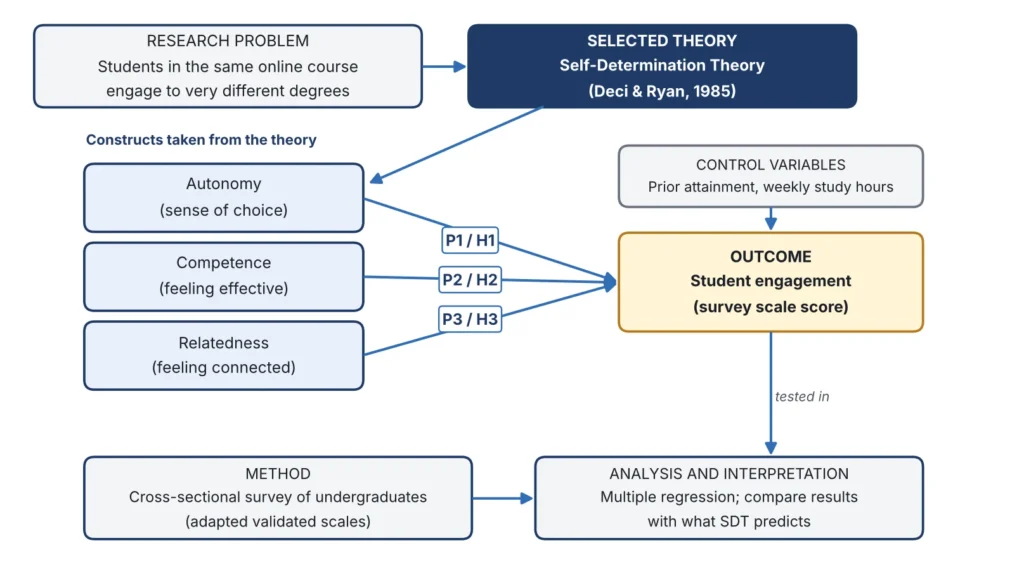
Figure 3. Study-specific conceptual model informed by Self-Determination Theory (illustrative). Each arrow corresponds to one proposition and one hypothesis.
Figure 3 presents a study-specific conceptual model informed by Self-Determination Theory. The theory provides the underlying explanation, while the model illustrates how its constructs are applied to this particular study.
Chapter 2 Theoretical Framework Example (Complete Sample)
Below is a sample of a theoretical framework written in academic style for the study above. It works as a theoretical framework example for thesis writers in the social sciences. Use it as a sample of a theoretical framework in research writing, not as text to copy: adapt the structure, and cite the original theorists for your own theory.
| 2.3 Theoretical Framework This study draws on Self-Determination Theory (SDT), a theory of human motivation developed by Deci and Ryan (1985) and summarized by Ryan and Deci (2000). SDT proposes that people engage most fully in an activity when three basic psychological needs are supported: autonomy, the experience of choice and ownership over one’s actions; competence, the feeling of being effective; and relatedness, the feeling of being connected to others. SDT was selected because the research problem concerns why students in the same online course engage to different degrees. Technology acceptance models explain whether students use a platform but say less about the quality of engagement once they are using it, and presence-based models of online learning focus on course design rather than individual motivation. SDT addresses variation between individuals directly and offers constructs that established instruments can measure. Recent work continues to apply it in education, including online settings (Bureau et al., 2022; Zhou et al., 2025). Three propositions guide the study. Students who perceive more autonomy in their course will report higher engagement (P1). Students who feel more competent will report higher engagement (P2). Students who feel more connected to peers and instructors will report higher engagement (P3). These propositions are translated into hypotheses H1 to H3 in Chapter 3, with prior attainment and weekly study hours included as control variables. SDT assumes that these needs are universal, although the ways they are satisfied differ across cultural and institutional settings. This assumption may not hold equally in every context, so the cultural fit of the survey instrument is treated as a limitation. The theory also says little about external constraints such as unreliable internet access, which are considered in the limitations section. In Chapter 5, the findings are interpreted by asking which needs were most strongly associated with engagement and where the results diverge from what SDT predicts. |
Theoretical Framework Examples in Research
The worked example above is one example of a theoretical framework in research, built in full. The shorter theoretical framework examples below show how theory works across designs. Each theoretical framework example in research below is constructed for illustration, so it is not a published study and reports no findings. Treat every theoretical framework research example as a pattern to copy in structure, not in wording. To see real ones, open the reference lists of recent theses in your university repository and read the framework chapters yourself.
Quantitative Research Example: Study Habits and Exam Performance
Research question: Are planning, monitoring, and reflection strategies associated with exam performance among first-year undergraduates?
Theory: self-regulated learning, which describes learning as cycles of forethought, performance, and self-reflection (Zimmerman, 2002).
How it informs the study: the three phases suggest what to measure, so the researcher can adapt a validated questionnaire, state hypotheses about associations, and analyze the data with regression (see these quantitative research examples for more designs of this kind).
What it does not do: an association would not prove that strategies cause better grades. Prior attainment and workload may matter too, so controls and limitations belong in the write-up. As an example of a theoretical framework in quantitative research, it shows theory guiding measurement without claiming proof.
Qualitative Research Example: Students’ Experience of Academic Stress
Research question: How do university students describe and respond to academic stress?
Theory: The transactional model of stress and coping (Lazarus & Folkman, 1984), which centers on how people appraise demands and the resources they believe they have.
How it informs the study: interview prompts can ask how students interpreted a demanding period, what resources they felt they had, and what they did next, and the model can inform a first round of codes.
What it may miss: the model centers on individual appraisal, so it may underplay housing, discrimination, or institutional policy. As an example of a theoretical framework in qualitative research, it shows theory acting as a lens that sharpens attention without fixing the themes in advance.
Business Research Example: Software Adoption in Small Firms
Research question: Why do some small firms adopt cloud accounting software while similar firms do not?
Theory: the Technology Acceptance Model (Davis, 1989), built on perceived usefulness and perceived ease of use.
How it informs the study: the two constructs become survey scales, and adoption intention becomes the outcome.
What it may miss: cost, regulation, and the owner’s financial literacy are not core constructs, so the researcher might add a second perspective and would need to say what each theory contributes.
Case Study Theoretical Framework Example: Institutional Pressure in One Organization
A case study theoretical framework helps decide what to look for in a single case and how to read it, without forcing the case to fit. A researcher studying why one hospital adopted a new reporting system might use institutional theory (DiMaggio & Powell, 1983) to look for coercive, mimetic, and normative pressures in documents and interviews, while staying alert to causes the theory does not name.
Theoretical Framework in Qualitative and Quantitative Research
The role of the theoretical framework in research methodology differs by design, but frameworks are not limited to one method. A theoretical framework for qualitative research usually works as a lens, while a theoretical framework for quantitative research usually supplies hypotheses and variables. The research question, the methodology, and your scholarly tradition decide how theory is used.
| # | Quantitative research | Qualitative research |
| Role of theory | Explains why a relationship is expected and supports hypotheses | Acts as a lens for questions, interview guides, and analysis |
| Typical output | Variables, hypotheses, often a model with arrows | Sensitizing concepts, guiding questions, an analytic lens |
| Use in analysis | Hypotheses are tested; results are read against the theory | Codes and themes may draw on the theory, but should stay open to what it misses |
| Main risk | Treating an association as proof of the theory | Forcing data into the theory’s categories |
For mixed methods, state which strand the theory guides and how the strands connect. In some inductive approaches, such as grounded theory, researchers deliberately let theory develop from the data, and an upfront framework may be replaced by a short statement of sensitizing ideas. Your supervisor and methodology tradition decide which applies.
Where Does the Theoretical Framework Go in a Thesis or Paper?
There is no single structure. Placement depends on the institution, discipline, and document type, so follow your handbook and your target journal’s instructions.
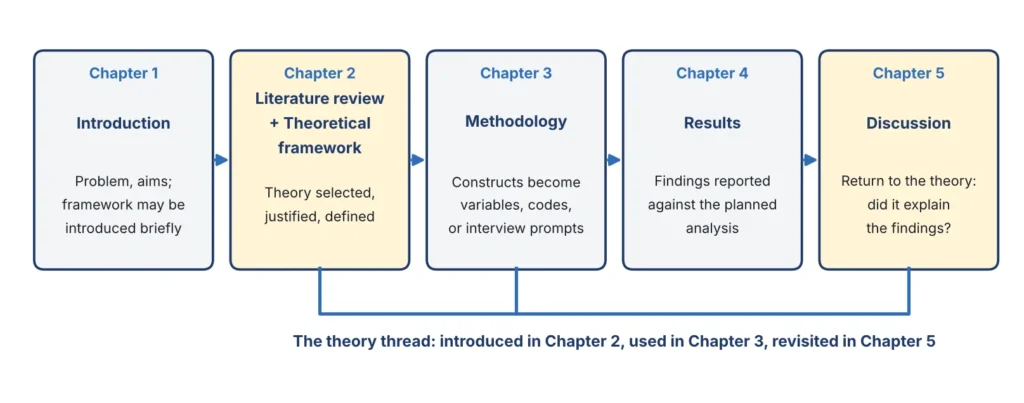
Figure 4. Where the theoretical framework sits in a typical five-chapter thesis, and where it returns.
Note: Chapter numbering and thesis structure vary across universities and disciplines; this figure illustrates one common five-chapter format.
- In a thesis: the theoretical framework in thesis chapters usually sits at the end of the literature review chapter or in a short chapter of its own, between the review and the methodology.
- In a combined chapter: some programs expect a Chapter 2 literature review and theoretical framework together, with the theory shaping how the literature is organized.
- In a research proposal: the theoretical framework in a research proposal is shorter. It names the theory, explains its fit, and shows how it will guide the study.
- In a journal paper: the theoretical framework in a research paper normally appears in the introduction or background in a few focused paragraphs. A research paper with a theoretical framework section of its own is more common in the social sciences and education.
Is It Chapter 1 or Chapter 2?
In many thesis formats, the framework appears in Chapter 2 because it develops from the literature review. Some programs introduce it briefly in Chapter 1 and develop it in Chapter 2, while others give it a separate chapter. Follow your institution’s structure, and return to the framework in the methodology and discussion.
What Comes First – Theoretical Framework or RRL?
The review of related literature usually comes first because it helps you identify which theories earlier researchers have applied before you justify your own choice. The two are not the same: the review surveys and evaluates what is known, while the framework selects and applies the theory that helps explain your problem. If you need a refresher, see our explainer on what RRL is in research. When the literature review and framework share a chapter, the selected theory can provide an organizing thread for the discussion that follows.
Theoretical Framework Format, Length, and Citation
Format. A written framework usually moves in this order: name the theory and its originator, define the key constructs, state the propositions, justify the choice, note assumptions and limits, and link everything to your questions and method. Use headings only if your institution’s template asks for them.
Length. There is no universal word count. A theoretical framework for research paper submissions is often a few paragraphs, shorter than the thesis version. In a dissertation, it is more often a section of several pages. Your handbook or the journal’s author guidelines decide. What matters is that the theory is named, explained, justified, and used.
Citation. Cite the original source of the theory, not only a textbook that summarizes it, and add recent applications in your field to show the theory is still in use. In APA style, the in-text form is (Ryan & Deci, 2000), and the full entry goes in your reference list; the APA author-date citation guidelines explain the variations for multiple authors and repeated citations. If you could only read a secondary source, say so (“as cited in”) rather than implying you read the original.
Common Mistakes When Writing a Theoretical Framework
| Mistake | What it looks like | Fix |
| Decorative theory | A theory is named in Chapter 2 and never mentioned again | Link at least one question, measure, or code to each construct, and return to it in the discussion |
| Theory too abstract | A grand theory with no measurable constructs | Pick a middle-range theory, or name the specific part you use |
| Stacked theories | Three or four theories, each in one sentence | Keep the ones that do a distinct job and state each job |
| Unsupported arrows | Relationships in the diagram that no theory or study supports | Draw an arrow only where you can cite a reason |
| Ignoring limits | The theory is presented as universally true | State its assumptions and where it may not fit your setting |
| Confusing it with the literature review | A summary of many studies, with no chosen theory | Select one theory and argue for it |
| Retrofitting | A theory chosen after the analysis to explain results | Choose before data collection, or say openly that the framework emerged from the data |
Theoretical Framework Template and Checklist
Copy the template below into your draft and replace the brackets. It follows the order of the worked example.
| Theoretical Framework Template 1. Research problem. [One sentence stating what you are trying to explain.] 2. Selected theory. [Name of theory], developed by [originator] ([year]), explains [what it explains in one sentence]. 3. Why this theory. This theory was selected because [reason tied to your problem and context]. [Alternative A] was considered but not selected because [reason]. 4. Key constructs. [Construct 1]: [definition in the theory’s terms]. [Construct 2]: [definition]. [Construct 3]: [definition]. 5. Propositions. P1: [relationship between constructs]. P2: [relationship]. P3: [relationship]. 6. Assumptions and limits. The theory assumes [assumption]. It may not explain [limit relevant to your study]. 7. Link to this study. The constructs are measured or explored through [variables, scales, interview prompts, or codes]. The propositions lead to [hypotheses or guiding questions], analyzed with [method]. |
Theoretical Framework Checklist
- The theory is named, attributed to its originator, and explained in your own words.
- Your choice is justified, and at least one alternative is considered.
- Key concepts are defined, and each one is used later in the study.
- Assumptions and limitations of the theory are stated.
- Every arrow in your model has a stated reason.
- The theory visibly informs your questions or hypotheses and your analysis plan.
- The section is distinct from your literature review.
- Original sources are cited, and the reference list is complete and in the required style.
- Tense, terminology, and length follow your institution’s guidelines.
- The discussion chapter has a place to return to the theory.
Once the full manuscript is drafted, a fresh reader can check the framework section for clarity, structure, and consistency. Professional academic manuscript editing services are one option for that last review.
Frequently Asked Questions
It is the established theory, or set of related theories, a researcher uses to explain a problem and guide a study’s design and interpretation.
There is no single official list. Four practical patterns are a single theory, multiple theories with separate jobs, a lens or perspective, and an adapted model that extends an existing theory.
The review of related literature usually comes first, because it shows which theories others have applied. The framework then selects the theory that explains your problem.
Most often Chapter 2, at the end of or alongside the literature review. Some programs introduce it in Chapter 1 or give it a separate chapter, so check your handbook.
No universal length exists. It is typically a few paragraphs in a journal paper and a section of several pages in a dissertation, so follow your institution or journal.
Cite the theorist who originated the theory, plus recent applications in your field, using your required style; for example, (Deci & Ryan, 1985) for the original and (Ryan & Deci, 2000) for an overview in APA.
Theoretical lens, perspective, underpinning, or basis. Check which term your supervisor expects, since usage differs.
Start from your problem, shortlist theories used in earlier studies, and compare them on relevance, assumptions, scope, and support. Choose the best fit and write the reason down.
Yes, if each theory does a distinct job and you explain how they fit together. Do not add theories to look thorough.
Not always. Many studies use one, but some exploratory or inductive projects build theory from data. Follow your discipline’s norms and your supervisor’s advice.
Yes. In qualitative work, the theory often acts as a lens for questions and analysis, while the researcher stays open to themes the theory does not name.
A literature review surveys and evaluates existing research. A theoretical framework selects and applies the theory that explains your problem.
Summary
A strong theoretical framework follows a clear process: define the problem, review the literature, compare candidate theories, justify one, explain its concepts, connect it to your questions, and check it against your design. It works when it is chosen for good reasons, visibly used, and honest about its limits. The same process applies whether you need a theoretical framework for thesis chapters or for a journal article. Revisit the checklist above before you submit, and let your supervisor or the target journal’s author guidelines have the final word on format.
