

An annotated bibliography is a list of sources where each citation is followed by a short note, called an annotation, that tells the reader what the source says and why it matters. That note is often 100 to 200 words, depending on the assignment, and it can summarize, evaluate, or explain how you plan to use the source.
What Is an Annotated Bibliography and Why Do Instructors Assign It?
Instructors usually assign it to check that you read your sources instead of just collecting them. It is also the cheapest way to find out, before you write the paper, that your three best sources all say the same thing. And it lets a reader decide which of your sources is worth opening first.
Three terms get mixed up, so here is the difference.
| # | Bibliography | Annotated bibliography | Abstract |
| What it is | A list of citations | Citations plus a note on each | A summary of one work |
| Who writes it | You | You | The original author |
| Main job | Show what you used | Show what each source says and why it matters | Preview a single study |
The abstract column is where students slip. Copying a source’s abstract into your annotation is easy, and instructors often notice. An abstract describes the study from the author’s point of view. Your annotation describes it from yours, so it should say something the abstract never would, such as how the source fits your question.
What Goes Inside an Annotation
Most annotations draw on three ingredients, and your assignment decides how many you need. A summary says what the source argues, studies, or finds. An evaluation names one real strength or limitation, based on what the source actually does. A reflection explains how the source helps your own research question.
Combine them, and you get the four types that library guides usually describe. The labels change from one university to the next, so treat them as functions, not rules.
| Annotation type | What it does | Use it when |
| Descriptive (or indicative) | Says what topics the source covers | The task only asks you to identify sources |
| Informative | Summarizes the argument, method, and findings | You need to show you understood the content |
| Evaluative (or critical) | Judges strengths, limits, and usefulness | The task asks you to assess quality |
| Combined | Summary, evaluation, and reflection together | You are building toward a paper or thesis |
How long should an annotation be?
Cornell’s library guide describes annotations of about 150 words, and one MLA-focused guide gives 50 to 200 words. Your assignment sheet wins over both. If it says nothing, 100 to 150 words per entry is a safe target, and a descriptive-only annotation can be shorter.
Three Annotated Bibliography Examples
Every entry has two parts. The citation is the source’s details written in a set format: the author, the date, the title, and where it was published, so readers can find the source. The annotation is the short paragraph under the citation, where you say what the source is about and why it matters. Read each annotated bibliography sample below as a model for how the two parts fit together.
The examples below show how an annotation changes with the task. They annotate fictional journal articles about survey research, so no real publication details are implied. In an actual assignment, replace the placeholder citation with a complete reference in the required style. In every box below, the line marked Citation is the source’s details, and the paragraph marked Annotation is the note written about it.
Descriptive APA Annotated Bibliography Example
Citation: Author, A. A. (Year). Title of article about questionnaire design. Journal Name, Volume(Issue), page range, DOI, or URL.
Annotation: This article explains how researchers can interpret ordered survey responses in educational settings. It introduces the difference between ordinal and interval measurement, discusses common analytical approaches, and explains why averages may hide differing response patterns. The article is written for researchers and educators who need a practical introduction to questionnaire analysis.
Why it works: This entry identifies the article’s topic, approach, key discussion, and audience. It describes the source without making a judgment about its quality or usefulness.
Evaluative APA Example
Citation: Author, B. B. (Year). Title of article on scale development. Journal Name, Volume(Issue), page range, DOI, or URL.
Annotation: This methodological article organizes questionnaire development into item creation, scale construction, and evaluation. Its explanations and examples make it useful for planning a student survey. However, the article presents a synthesis of existing guidance rather than a systematic review, so its recommendations should be checked against the specific research population and current evidence. It supports planning decisions but does not provide a ready-to-use questionnaire.
Why it works: This entry summarizes the source and assesses a relevant strength and limitation. The evaluation is based on the article’s stated approach rather than an unsupported claim about reliability.
Combined MLA Annotated Bibliography Example
Citation: Author, C. C. “Title of Article on Survey Response Analysis.” Journal Name, vol. X, no. X, Year, pp. XX–XX.
Annotation: This article examines how researchers can analyze ordered survey responses and explains why analytical choices should be reported clearly. For a project on student feedback questionnaires, it provides an accessible introduction to measurement issues and the limitations of simple averages. Because it is a short editorial rather than a full validation guide, it would be most useful alongside more detailed scale-development resources. It helps frame the analysis problem rather than providing a universal rule for every dataset.
Why it works: This annotation combines summary, evaluation, and relevance. It explains both what the source discusses and how it could support a specific research question.
APA vs MLA: the same citation written both ways
The two styles write a journal article citation differently. Here is the same fictional article in each one.
APA citation: Author, A. A., & Author, B. B. (Year). Title of article in sentence case. Journal Name, Volume(Issue), page range.
MLA citation: Author, First Name, and First Name Author. “Title of Article in Title Case.” Journal Name, vol. X, no. X, Year, pp. page range.
| Part | APA | MLA |
| Author names | Last name and initials | Last name and full first names |
| Date | In parentheses, right after the authors | Near the end, after the volume and issue |
| Article title | Sentence case, no quotation marks | Title case, in quotation marks |
| Journal details | Volume in italics, issue in parentheses: Volume(Issue) | Written out: vol. X, no. X |
| Page range | Numbers only | Starts with pp. |
The annotation underneath does not change between the two. Only the citation above it does.
Weak vs. strong: the same source, rewritten
Here is the kind of annotated bibliography example that loses points. It is about an invented journal article on spaced practice, so the details in the notes below are made up.
Weak annotation: This article is about studying. It is a good source and very reliable because it was published in a journal. It will be useful for my paper.
And here is a stronger version.
Strong annotation: The authors compare spaced practice with last-minute cramming in a group of 60 undergraduates and find that spaced practice led to better scores on a later test. The sample comes from one university, so the result may not hold elsewhere. For my paper on exam preparation, I will use it as evidence for spacing study sessions and compare it with a study from another country.
The weak version praises the article without a reason, names no finding, and ends on a promise. The strong one states the finding, admits the study’s limit, and says what the writer will do with it.
How to Write an Annotated Bibliography in 10 Steps
Wondering how to do an annotated bibliography without it eating your week? Follow the steps in order, and keep your notes in one file from the start.
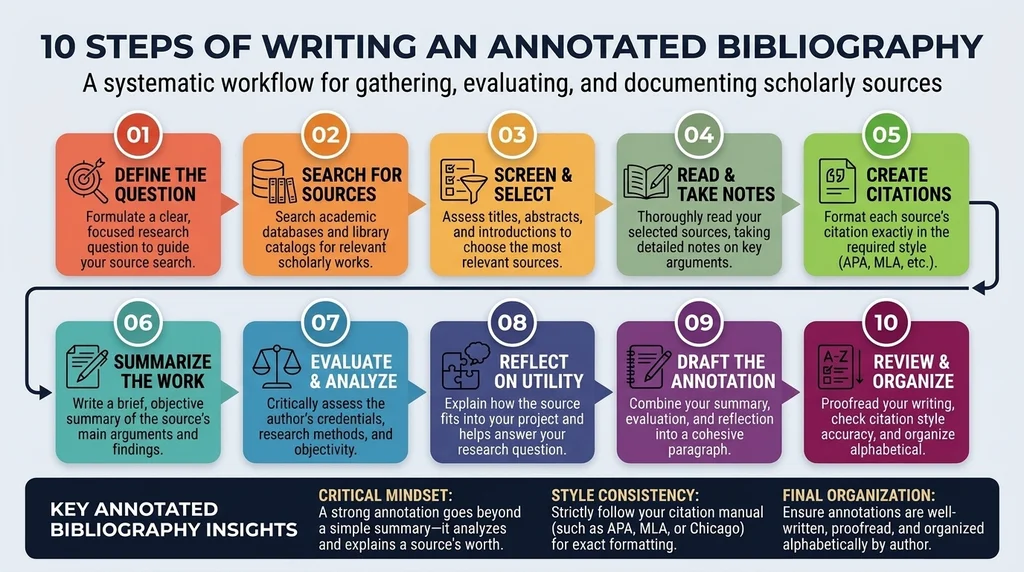
1. Define the question
Narrow a broad topic into one question. “Student learning” is too wide. “How do postgraduate students judge the usefulness of supervisor feedback?” is something you can search.
2. Search for sources
Use your library catalog and subject databases. Search with two or three key terms plus their synonyms, and check the reference lists of good hits for leads.
3. Screen and select
Read titles and abstracts, then keep the sources that bear on your question. Include one that disagrees with the rest if you can find it. An annotated bibliography where every source agrees is a warning sign.
4. Read and take notes
Read the parts of each source that carry its argument and evidence. If you only read the abstract, say less in your annotation, or go find the full text.
5. Create the citation
Build each citation in the style your course requires. Check imported records from a citation manager against the original, because imported records can have missing authors or wrong page ranges.
6. Summarize the work
Write one sentence answering “what does this source argue or find?” Do it from your notes, then reopen the source and check you did not change “linked to” into “causes.”
7. Evaluate and analyze
Find one strength or limit and tie it to something concrete, such as the sample size, the method, or the type of publication. “Reliable” is not an evaluation.
8. Reflect on its use
Say what the source does for your project. It might supply a method, a definition, a contrasting view, or evidence for a claim.
9. Draft the annotation
Join the pieces into one tight paragraph and cut anything that repeats the citation. Keep entries a similar length so no source looks like an afterthought. Our guide to ways to improve academic writing clarity helps with the trimming.
10. Review and organize
Check that each annotation matches its citation. Then order the entries alphabetically by the first word of each citation, unless the assignment asks for a thematic or chronological order.
Annotated Bibliography Format: APA vs MLA
Both styles put the citation first and the annotation directly beneath it. The differences are in the indents and the title.
| # | APA 7 | MLA 9 |
| Citation | Hanging indent, 0.5 inch | Hanging indent, 0.5 inch |
| Annotation | New line, indented 0.5 inch from the left margin | New line, indented 1 inch from the left margin |
| Extra paragraphs | First line indented another 0.5 inch | First line indented another 0.5 inch |
| Spacing | Double-spaced | Double-spaced |
| Title | Bold and centered at the top of the first page of entries | “Annotated Bibliography” or “Annotated List of Works Cited” |
| Order | Alphabetical by first citation element | Alphabetical, unless the task says otherwise |
APA annotated bibliography format
Ask whether your task wants a title page, because course requirements differ. If it does, put page numbers in the top right corner of every page, including the title page.
MLA annotated bibliography format
MLA leaves some layout choices to instructors, so if your assignment sheet conflicts with the table above, follow the sheet. The citation differences between the two styles are shown in the APA vs MLA example earlier in this guide.
Annotated Bibliography Template
Copy this annotated bibliography template into your draft and fill the brackets. It works for both styles. Only the citation changes.
Citation: Full APA or MLA entry for your source.
Summary: [Author] examines [question or topic] using [method or evidence] and concludes [main finding or argument].
Evaluation: The source is useful because [specific strength]. It is limited by [specific limitation].
Reflection: For my question about [your topic], it will help me [specific use], especially next to [another source that disagrees or adds].
Filled in, these parts make a short paragraph. Add detail until you reach the word range in your assignment.
Annotated Bibliography vs Literature Review
An annotated bibliography handles sources one at a time. A literature review connects them, showing where researchers agree, where they clash, and what nobody has studied yet. Your annotations are raw material for that synthesis, but stacking them in a row does not create it.
When you are ready to turn your notes into a written review, our guide to systematic literature review vs literature review helps you pick an approach, and the guide to RRL in research shows how a related literature section is written.
Annotated Bibliography FAQs
Use the number your instructor gives you, and ask if none is given. Using another course’s number can cost you points.
Only if the assignment allows it. Some guides call phrase-style notes “telegraphic,” and some instructors accept them, but full sentences are the safe default.
Not quite. A works cited page lists the sources you quoted or referenced in a paper. An annotated bibliography adds a note to each source and may include sources you read but did not cite.
Usually not, but some instructors ask for a short one explaining your topic and how you chose sources. Check the brief.
Sometimes. The reflection part often uses “I,” but some instructors want a neutral third-person voice, so ask before you commit.
A generator can format the citation, but check it against the source because errors slip in. It cannot read the source for you, and some courses restrict AI tools, so check your course policy before using one for the annotation itself.
Yes, if the assignment allows non-scholarly sources. Cite them in the format your style uses for that type, and judge them with the same questions: who made it, why, and how much you can trust it.
Get Help With Your Research Writing
If your annotations are part of a thesis or a journal article, our research consultancy service can help you plan the literature search and structure the review, and our manuscript editing services can tidy the final draft before you submit.
Before you start, spend ten minutes on the assignment sheet. Write down the citation style, the number of sources, the word range per entry, and whether it wants a summary, an evaluation, or both. Then write your first annotation, and use it as the model for the rest.