

A Likert scale is a questionnaire measurement approach that uses ordered response options to capture attitudes, opinions, or perceptions. Strictly, a Likert scale combines related items measuring a construct, while a single rated question is called a Likert-type item.
What Is a Likert Scale Measuring?
A useful Likert scale definition separates three components:
- Construct: The concept, such as perceived supervisory support.
- Item: The statement or question respondents evaluate.
- Response format: The ordered choices, such as degrees of agreement.
A questionnaire may contain several constructs and standalone ratings. Only combine items into a score when theory and measurement evidence justify doing so. Shared answer options alone do not establish that items measure the same thing.
This Likert scale definition guides the practical choices below: Define the construct first, not the numbers. Reuse a suitable established measure where possible, checking permissions and its evidence for your population.
Likert Scale Examples From Academic Research
These original Likert scale question examples show why labels must match the question. They are illustrative, not validated instruments.
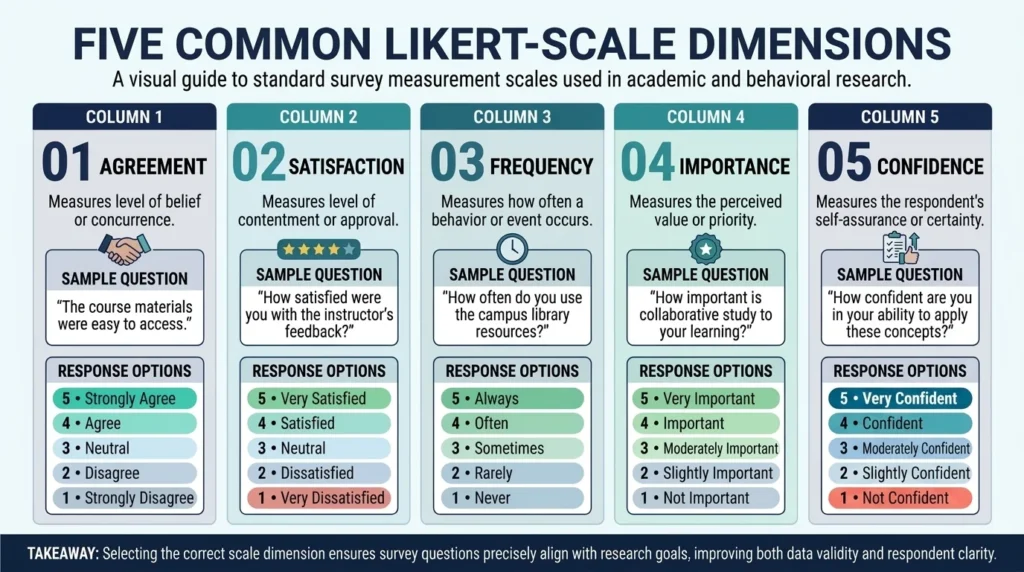
- Agreement: “My supervisor explains the next research milestone clearly.” Options: strongly disagree, disagree, neither agree nor disagree, agree, strongly agree.
- Satisfaction: “How satisfied are you with access to laboratory equipment?” Options: very dissatisfied, dissatisfied, neither satisfied nor dissatisfied, satisfied, very satisfied.
- Frequency: “During the past four weeks, how often did you use the library’s research databases?” Options: never, rarely, sometimes, often, always. Pretest whether these terms have consistent meanings.
- Importance: “How important is open access when choosing a journal?” Options: not at all important, slightly important, moderately important, very important, extremely important.
- Confidence: “How confident are you that you can interpret a confidence interval?” Options: not at all confident, slightly confident, moderately confident, very confident, extremely confident.
These Likert-scale examples cover different measurement purposes. Do not attach agree–disagree labels to a direct satisfaction question. “Always” measures reported frequency, not a measured event count.
Types of Likert Scale Questions and Response Formats
Agreement, satisfaction, frequency, importance, and likelihood describe response dimensions, not a universal taxonomy of separate scales. For likelihood, ask, “How likely are you to attend the next methods workshop?” with options from very unlikely to very likely.
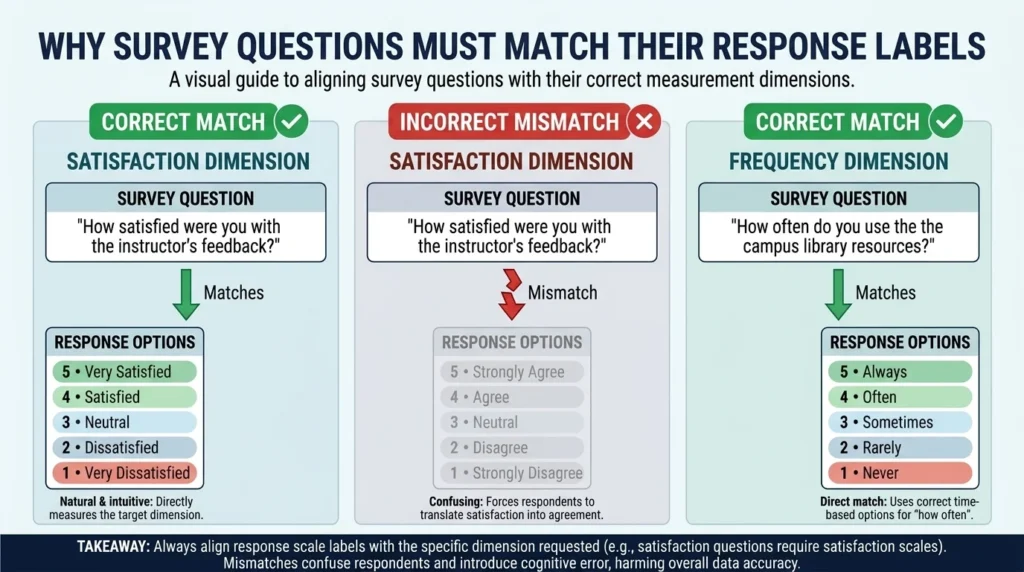
Unipolar formats measure an amount from none to a high degree, such as not at all confident to extremely confident. Bipolar formats span opposing directions, such as dissatisfaction to satisfaction.
Balanced bipolar options provide comparable positive and negative categories. An agreement set with three favorable choices but only one unfavorable choice is unbalanced. Balance concerns the labels, not equal numbers of people selecting each answer.
A middle option in a unipolar format can mean “moderately,” not neutrality. Treat “don’t know” and “not applicable” as distinct states where relevant, not interchangeable midpoint labels.
Choosing Four, Five, or Seven Response Points
The comparison below uses agreement examples; other constructs need appropriate labels. No format is universally superior.
| Format | Example response options | Main advantage | Potential limitation | When suitable |
| 4-point | Strongly disagree; disagree; agree; strongly agree. | Fewer categories; no neutral midpoint. | Can force a directional answer from genuinely neutral respondents. | When the construct and pretesting justify omitting neutrality. |
| 5-point | Strongly disagree; disagree; neither agree nor disagree; agree; strongly agree. | Allows a meaningful middle response with relatively few distinctions. | Some respondents need distinctions between the available labels. | When target respondents can use all five labelled categories. |
| 7-point | Strongly disagree; disagree; slightly disagree; neither agree nor disagree; slightly agree; agree; strongly agree. | Adds distinctions within each direction. | More labels and potentially greater response burden. | When respondents can meaningfully distinguish adjacent categories. |
A 4-point Likert scale removes the neutral category in this bipolar example; it does not remove uncertainty. A 5-point Likert scale offers a central category, while a 7-point Likert scale adds distinctions that must be understandable to respondents.
Build the Question Before Building the Form
Effective survey items address one clear idea in neutral, familiar language. Avoid double negatives, vague timeframes, and assumptions that every respondent has the relevant experience.
Weak: “My supervisor is helpful and always replies quickly.”
Improved: “My supervisor’s feedback helps me identify my next revision.” Ask response timeliness separately if it matters to the study.
Keep response direction consistent, make every label understandable, and check that options cover relevant experiences. Pilot the wording and layout with people resembling your participants; ask them to explain how they chose their answers. Test interpretation, not just whether the form submits successfully. Keep ordered categories in order; do not randomly shuffle individual response anchors.
Research question examples can help connect a broad topic to a measurable objective. Your research methodology should explain why the construct, items, sampling, and analysis fit that objective.
A Likert Scale Questionnaire Template
This Likert scale template explores the perceived usefulness of supervisory feedback. It is an unvalidated starting point, not a ready-made psychometric instrument.
Instruction: “Thinking about feedback received during the past four weeks, indicate your agreement with each statement.”
1. The feedback helps me identify revisions to make.
2. The feedback clarifies why a revision is needed.
3. The feedback makes the next step in my work clearer.
4. The feedback helps me judge whether a revision addresses the issue.
Use one consistent five-category agreement response set, from strongly disagree to strongly agree, with neither agree nor disagree at the center. Screen for whether feedback was received; do not force participants without that experience to invent a rating.
Adapt this Likert scale template to your research question and evaluate its content, dimensionality, reliability, and validity before claiming an overall score measures feedback usefulness.
Use the Instrument Within a Research Plan
A Likert scale questionnaire can support education, psychology, business, healthcare, and social science studies. Define the construct and question, check existing measures, select items and labels, obtain the appropriate consent or approvals, pilot, collect responses, then code and analyze.
These quantitative research examples show how structured responses fit a wider design. A large response count does not itself make a convenience sample representative.
For design questions, research consultancy services can be scoped around instrument selection and analysis planning. Authors remain responsible for methodological decisions; no support service guarantees valid results.
Likert Scale Scoring Before Statistical Testing
Assign ordered codes consistently, such as 1–5 from strongly disagree to strongly agree. For reverse-keyed items in an established instrument, follow its scoring instructions: on a 1–5 coding, reversal is 6 minus the original value. Do not confuse reversing item scores with flipping response labels on screen. Keep missing and not-applicable responses outside the substantive score categories.
What Is a Likert Scale Score?
It may refer to a single item’s coded response or a composite score; specify which. If four items legitimately form an equally weighted scale, complete responses of 3, 4, 4 and 5 sum to 16, or average to 4. Neither operation validates the scale.
Define the missing-data rule in advance rather than converting omissions to zero. Specify how many answered items permit a composite; use the instrument’s rules, not ad hoc mean substitution. Report the scoring direction, possible range, and what higher scores represent. Likert scale scoring should follow the instrument and construct, not a convenient spreadsheet total.
How to Analyze Likert Scale Data
Start with the research question, study design, and unit of analysis, not a preferred test.
Individual Items
Report counts and percentages in each category. Add the mode or an appropriate median category; ordered bar charts preserve the distribution. Cross-tabulation can show how responses vary between groups.
For inference, possible approaches include Mann–Whitney U for independent groups, a design-appropriate paired ordinal method for repeated observations, or Spearman correlation for ordered associations. Their assumptions and targets differ; they are not interchangeable “Likert tests.” Account for clustering or repeated responses where present.
Multi-Item Scores
Before combining items, examine content and dimensionality. Assess relevant reliability evidence, such as internal consistency using alpha or omega when appropriate. Reliability does not establish validity or prove one dimension. Content review, cognitive interviews, factor structure, and relationships with relevant measures can support the intended interpretation. Avoid deleting items solely to raise alpha.
An item-level numerical mean is sometimes used as an approximation, but justify its assumptions and show the categories; it does not turn an ordinal item into interval measurement.
When deciding how to analyze Likert scale data, describe the instrument, sample, distribution, missingness, and assumptions. There is no single analysis for every survey.
How to Interpret Likert Scale Data
Interpret the distribution before its average. In an illustrative example, ten responses at 1 and ten at 5 have the same mean as twenty responses at 3, but the first group is polarised and the second consistently selects the midpoint. These are hypothetical responses, not research findings.
Explain higher scores in terms of the construct. A score of 4 is not “twice as satisfied” as 2, and an arbitrary mean band does not establish a validated low, medium, or high classification.
For how to interpret Likert scale data in a paper, report denominators, uncertainty, and limitations alongside any summary score. Association does not establish causation. If reporting “agree” plus “strongly agree” together, explain the grouping and retain the full distribution; collapsing categories loses detail.
Quantitative Responses and Ordinal Measurement
Is a Likert Scale Quantitative or Qualitative?
The raw responses are ordered categories commonly analyzed in quantitative research. They are not qualitative interview material simply because they measure opinions. Open-ended explanations can be collected separately.
Is a Likert Scale Ordinal or Interval?
Individual items are generally ordinal: their order is known, but equal category distances are not automatic. Some composite scores are treated as approximately interval under justified conditions. Summing items does not by itself establish that property.
Building a Likert Scale in Google Forms or Qualtrics
For a Likert scale in Google Forms, a multiple-choice grid can place statements in rows and fully labeled options in columns. A linear-scale question is another rating option, but Google documents endpoint labels rather than labels for every intermediate value. Leave “Limit to one response per column” off for independent ratings: several items may legitimately receive the same answer.
For a Likert scale in Qualtrics, the Matrix Table’s Likert variation offers statements and scale points. Choose “Allow one answer” for a single rating per statement.
Check numeric export values rather than assuming visual order determines coding. Qualtrics distinguishes export recodes from its separate scoring feature; test both if used.
Preview on phones and test an exported response. Software layout does not create a validated instrument. If preparing a thesis paper, a thesis-to-journal article conversion service should preserve the questionnaire, scoring decisions, and study limitations, not strengthen claims beyond the evidence.
Advantages, Limitations and Design Checks
Ordered ratings are efficient, familiar, and useful for comparing structured responses. However, acquiescence, social desirability, midpoint preference, extreme responding, and fatigue can distort answers.
Use neutral wording, relevant items, manageable length, and privacy arrangements you can actually deliver. Keep labels consistent and test translations with the intended audience. Reverse wording is not universally required; it can confuse respondents. Check accessibility and do not mistake a convenient format for sound measurement. For comparisons across languages or groups, investigate whether items function comparably instead of assuming translation guarantees equivalence.
Final Research Check
Answering “what is a Likert scale” is only the first step. Before collection, confirm the construct, item wording, response format, coding, and analysis plan. Before publication, explain what the scores support and where uncertainty remains.
Frequently Asked Questions
Strictly, it is a multi-item measure using ordered ratings; everyday usage often includes individual Likert-type questions. State which meaning you use.
Agreement, satisfaction, frequency, importance, and likelihood are common response dimensions. Choose labels that match the question, not a universal default.
It offers five ordered choices. The center can represent neutrality in a bipolar format or a moderate amount in a unipolar format.
It offers seven ordered choices. Extra distinctions are useful only if respondents can understand and use them meaningfully.
It supports quantitative analysis of ordered categorical responses. Optional written comments are a separate qualitative data source.
Individual responses are ordinal. Approximate interval treatment of a composite requires methodological justification, not simply numeric coding.
Apply the instrument’s coding and direction, including any reverse-keying. Combine related items only when justified, and document missing-data handling.
Inspect response distributions, then explain the score’s direction and limitations. Avoid unsupported labels or ratios of satisfaction.
There is no universal minimum or ideal count. Coverage, dimensionality, burden, and measurement evidence should guide selection.
An item is one rated statement or question; a scale combines related items into a justified measure. Several rows in a grid do not automatically form one.